
Diamondbacks 2026 pitching preview: Can this staff better support the offense?
Here is a list of five questions that will determine whether the Diamondbacks' pitching can find stable ground in the pennant chase this year:

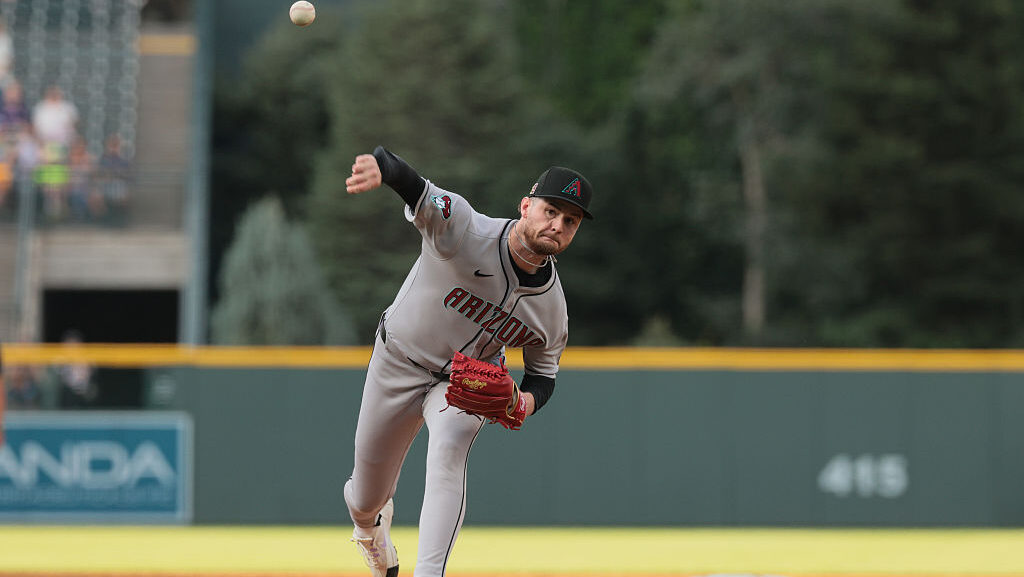
Ryne Nelson #19 of the Arizona Diamondbacks pitches against the Colorado Rockies during the first inning at Coors Field on August 16, 2025 in Denver, Colorado. (Photo by C. Morgan Engel/Getty Images)
(Photo by C. Morgan Engel/Getty Images)
PHOENIX — What will it take for the Arizona Diamondbacks to exceed expectations in 2026?
The D-backs were preseason power ranking darlings in 2025 but failed to live up to the hype for very many reasons, such as pitching health, poor defense and an inconsistent starting rotation.
National outlets have responded predictably, placing Arizona in the middle of the pack as a fringe contender for the final National League Wild Card spot.
The narrative over the past couple years has been clear. The Diamondbacks led baseball in runs scored across 2024-25, and the next highest scoring team to miss the postseason in both years was the Minnesota Twins at 16th.
As manager Torey Lovullo and general manager Mike Hazen have said leading up to Opening Day, taking a step forward starts with pitching and defense for October baseball to be a possibility. Offseason moves in the starting rotation and on the infield reflect that.
Here is a list of five questions that will determine whether the D-backs’ pitching can find stable ground in the pennant chase this year:
Diamondbacks’ pitching questions heading into 2026
How good will Zac Gallen be?
Bringing back Merrill Kelly and Zac Gallen sets up a starting rotation that is essentially the same as last year between Corbin Burnes’ Tommy John surgery and the trade deadline, specifically once Kelly returns after a short injured list stint (back tightness).
The biggest difference until Burnes gets back in July (if all goes accordingly) will be whether Gallen is August-September Gallen or March-July Gallen.
The 2023 All-Star struggled mightily four months into his walk year and opted to come back to Arizona on a one-year contract to try again in free agency next winter. He finished the season with an ERA of 4.83, the worst of his career (was previously 4.30 in 2021), but he worked eight quality starts in his last 11.
Gallen focused on his physicality this offseason after finding delivery solutions late last year.
“I’m sure he’s got a little chip on the shoulder,” pitching coach Brian Kaplan told Arizona Sports. “I think he refocused a little bit this offseason on some of his lifting program and some of his throwing program just to add a little more power and intent to everything he was doing.
“He’s just a very technical person, both mentally and physically, so I think recapturing some of the physicality and challenging himself a little bit just to kind of get a little more comfortable in those situations I think has already shown itself.”
Gallen averaged 94 mph on the fastball this spring, which he has not done over a regular season since 2022, his best campaign.
He will get the ball on Opening Day to start a walk year redo.
“I think I felt like I owed it to myself, owed to my family, I even owed it to the organization, the fans here, to come back, have a good year and prove my worth again,” Gallen said.
Can the Diamondbacks field a top-half rotation?
Moving onto the rest of the group, last year felt like it was on the low end of the spectrum for what the rotation was capable of.
Arizona finished fourth in MLB in quality start percentage (42%), but it also compiled the fourth most starts with at least five earned runs allowed (71). The D-backs won only 17% of those games, as the rotation simply has to do a better job of giving the team a chance in all five days.
Gallen played a role in that, but so did the inconsistencies of Brandon Pfaadt and Eduardo Rodriguez.
Rodriguez — the only lefty on the team — started to right the ship and was OK after the All-Star break (4.01 ERA). He had the start of the World Baseball Classic this spring to build off of.
Pfaadt has worked on his delivery this offseason to improve the effectiveness of his arsenal, most notably the sweeper that should be his putaway pitch. In 2024, opponents hit .215 against the pitch and righties hit .180. Last year, those numbers went to .270 and .260, respectively, with a lot more slug.
“We attacked the delivery first,” Kaplan said of Pfaadt. “He just kind of was getting a little too around everything and wanted to get his momentum going more to the plate.
“I don’t think the sweeper shape is any different, but I think the line is much better. It’s holding its line a little longer in the ball flight before it kind of takes a left-hand turn, so I think hitters are struggling to see it.”
Kelly making up a top of the rotation with Gallen again was not expected to be possible and is a comforting story given their importance to the 2020s Diamondbacks and connection as friends who have been here since 2019. The duo needs to provide stability to the top of the rotation like it had for much of the decade to lessen the burden on the bullpen and stop skids that happen throughout a season.
What does bringing back Zac Gallen do for the 2026 Diamondbacks?@Burnsy987 and @alexjweiner discuss how Gallen's return may be a "giant insurance" policy for their starting rotation with Corbin Burnes on the shelf.
Watch the latest @AintNoFang episode here:… pic.twitter.com/iyW1mVhKdN
— Arizona Sports (@AZSports) February 17, 2026
Ryne Nelson, however, is arguably the pitcher to watch in terms of ceiling this year, as the right-hander excelled in the second half of 2024 and handled a leap from the bullpen back into the rotation beautifully last season. Since July 2024, Nelson is 18th among major league pitchers with a 3.27 ERA (minimum 200 innings).
He has been firing heat this spring with an average of 96 mph with a fastball that has elite rise (induced vertical break).
Even with a secure rotation spot entering this season, Nelson has pitched with an edge.
“You’re never really outside of the bubble,” Nelson said. “I feel like you have to keep competing and keep earning your job every time you go out there.”
The new face is Michael Soroka, who will start the home opener after he sought an opportunity to prove that the underlying health concerns that kept him off the field over the past few years have been handled. He will be needed for pitching depth in whatever capacity the club sees fit once Kelly comes back, which has not been decided.
Burnes is pushing to return by the All-Star break, saying he is hyper focused on command in his throwing program to be as sharp as possible when the day comes.
Even if he has to work back into his ace form, that’s a big-time arm to get back before the trade deadline, and the biggest carrot dangling for the Diamondbacks as they fight to hang on. He could be the midseason addition that makes the biggest difference in a potentially crowded NL Wild Card chase, the elephant in the infirmary so long as Arizona has a chance to contend.
How will this team close games?
The Diamondbacks have not named a closer, although all signs point to free agent returnee Paul Sewald getting the first opportunities.
It’s risky. Even though Sewald looked solid in spring training, he has not been a closer since he lost the job in July 2024 with Arizona.
That said, the bullpen will evolve seemingly countless times this season. Younger arms are going to play a factor. Pitchers will get hurt. There are no lefties in the bullpen now but there will be at some point.
“I mean, the bullpen construction in the game today is pretty much in five-day increments,” Hazen joked to Arizona Sports’ Wolf & Luke.
All while co-closers Justin Martinez and A.J. Puk rehab from elbow surgeries to return, with the latter well ahead of the former. Puk expects to be back in the first half, while Martinez might be able to return by late August.
Arizona’s bullpen was actually pretty good to start last season when healthy, but it ended with a league-record 17 pitchers having made saves and 29 blown saves leading the National League.
It is traumatic for a team to fumble leads often, as evidenced by some flat performances the day after blown saves last year.
Reasons for optimism within the fog include:
- Ryan Thompson had a 2.00 ERA in the second half last season.
- Taylor Clarke is coming off a career year, and his .672 OPS allowed to lefties could be a solution to having no southpaws.
- Jonathan Loaisiga has electric stuff with a fastball that nearly hit triple digits this spring. He is a ground ball machine, and an improved defense should help him.
- Juan Morillo was sharp this spring, and his fastball-slider combination played in stretches as a rookie last year when he threw strikes. That was a focus this winter. Look for him to take on higher leverage roles if that continues.
- Andrew Hoffmann was also impressive in camp, improving his slider to perform against righties as his changeup had been effective versus lefties.
There are also a number of young relievers making their way, including Brandyn Garcia, who has quality stuff from the left side but had to throw more strikes this spring to make the team.
At the same time, the left-handed pitching depth is lacking, and a few steps back from veterans will put a lot of pressure on young relievers without much experience to carry the load again. Pushing the right buttons is going to be a challenge for Lovullo to start the year.
How much of a difference will the defense make?
The D-backs made seven errors in their first five games last year which set a sour tone that this would not be a typical Lovullo-type team.
Arizona’s pitching staff was middle of the pack in strikeout percentage, so it relied on the defense picking up the baseball.
It’s why third baseman Nolan Arenado and first baseman Carlos Santana were targeted this winter to man the corners. They have declined offensively, but the defense has remained solid (just watch Arenado’s WBC highlights).
The outfield at least is going to very athletic with Corbin Carroll, Alek Thomas, Jorge Barrosa, Tim Tawa and now Jordan Lawlar, who has looked comfortable since making the move from the infield.
“It’s good to have athletes, guys that can track the ball down and I think we’re all familiar with each other to the point where the communication and all that’s good,” Carroll said.
There are going to be learning moments for Lawlar, as Hazen made the point that playing outside in Arizona and at Chase Field is going to be a different experience than facing the winds at Oracle Park or Wrigley Field. But everything with Lawlar’s breaks and instincts have been promising.
Speaking of, Lovullo mentioned Thomas’ breaks and routes have been elite this spring, as a resurgent defensive season from a two-time Gold Glove finalist would help recapture the No Fly Zone. How Thomas and Lawlar are slotted into left and center field will be an early season storyline.
Lawlar’s ability to handle the outfield will allow the D-backs to work Lourdes Gurriel Jr. into the picture as primarily a designated hitter coming off ACL surgery, perhaps as early as sometime in April.
Has pitching philosophies changed?
Kaplan admitted that early in his first year as pitching coach he may have “tipped the scales too much” to focusing on the opposing hitters’ weaknesses.
That’s still an important element of game preparation, but he said the pitching staff had to do a better job of maximizing its own strengths, which was evident in the final two months.
“We needed to better weaponize our own guys and continue to challenge our guys with arsenals and physicality and let them get lost in the game a little bit and inside what they need to focus on,” Kaplan said.
The Diamondbacks hired Jeremy Bleich as an assistant general manager this offseason to help steer pitching development into a more successful direction.
Related
 Diamondbacks' Opening Day roster becomes clear, and there are no left-handed relievers
 Surviving brutal early 2026 schedule is key to Diamondbacks' season
 5 standout Diamondbacks hitters and pitchers this spring training
 National League Wild Card landscape: What teams do the Diamondbacks have to compete with?
 Gabriel Moreno wins award for best Venezuelan player in MLB this season
 MLB testing new outfield rules in Arizona Fall League

Comments
5 Comments
There is the Dodgers, then there are the rest of the so called MLB. So who cares if your best outcome is a participation trophy. I hope MLB gets it right in 2027. But they will probably chicken out and just add more playoff teams and efff the salary issues.
That's a terribly long article that leads to a simple answer to the headline question.
NO.
I think you can use WBC innings to analyze Erod.