
Do NBA Draft lottery changes hurt or help Suns’ unprotected traded picks?
The Phoenix Suns traded a handful of their first-round picks, and the value of those has changed with the new lottery rules.

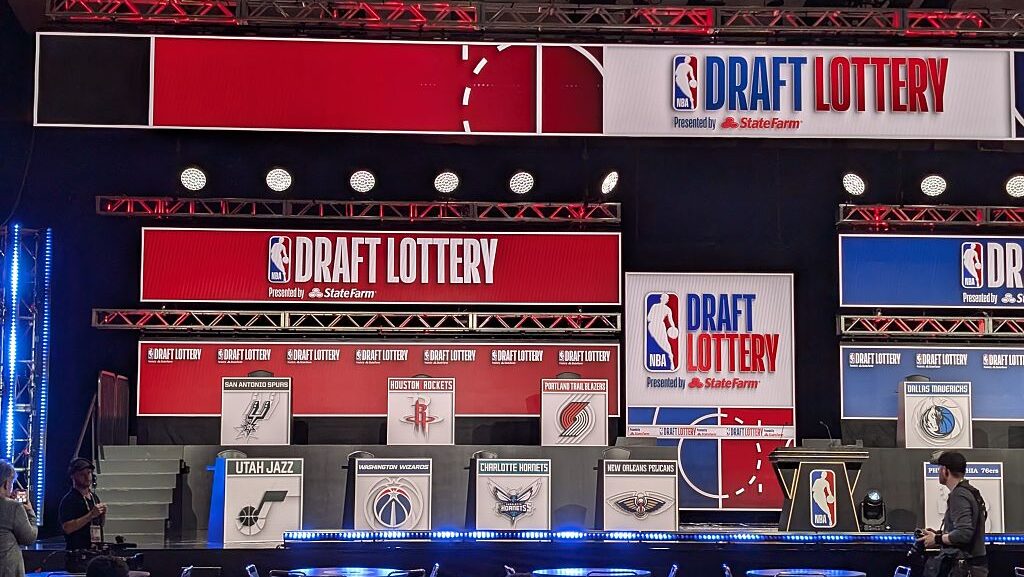
Players, team members and other participants gather to attend the NBA Draft Lottery in Chicago, Illinois, United States on May 12, 2025. (Photo by Jacek Boczarski/Anadolu via Getty Images)
(Photo by Jacek Boczarski/Anadolu via Getty Images)
For something we complain about a whole lot, strategy within sports is often more subjective than we allow it to be.
This comes to mind with the NBA’s lottery tweaks that were finalized on Thursday, designed to eliminate tanking while unintentionally having major ramifications for the transactional future of the league’s trade market.
More on that later, but the rule changes also affect teams that made significant, franchise-altering maneuvers involving first-round picks.
That, of course, applies more to the Phoenix Suns than anyone. The value has now been altered on the unprotected selections they dealt in 2027 and 2029, as well as the 2028 pick that has swaps attached. These changes are in effect through at least the 2029 draft, but could very well stick to some degree to affect the 2030 swapped-out first and 2031 unprotected first sent to Utah.
Is that value for the teams that own those picks now better? Did the Suns get screwed by these rule changes, like they were by the aprons the moment they were owned by someone willing to spend big?
Well, that’s subjective. Digest the new rules below, explore some of the hypotheticals and decide for yourself. That’s right. I’m not here to deliver some brash and bold take. It’s up to you, the reader. Confusing, I know.
Alright, let’s hash this out.
Simplifying the complicated lottery rules
We are going to analyze almost all of these changes through the optics of the Suns’ traded picks, so if you want an explainer on the new rules, here is ESPN’s A-B-C, 1-2-3 breakdown for ya. The simplest explanation is the lottery odds have been flattened for picks 1-16, meaning they are more evenly distributed.
The principle and trade-off to understand is that the extremely high value of top-end lottery picks and how they guarantee a certain selection — before the lottery — is gone. If you finished with the worst record in the league, even after the odds were shifted a few years ago, you would at worst get a top-5 selection while sharing the best odds on finishing top-4.
That is no longer the case. Instead, it’s pretty much that anyone can end lottery night picking anywhere.
Anything can happen with these odds now. It’s a lottery ball draw for every single spot in the top-16. We were only doing this previously for the top-4.
Now, there are obvious flaws here at the cost of cutting down on the majority of tanking. The solution was always going to be imperfect to accomplish that, and here we are. Teams, especially in smaller markets that don’t attract free agents, are more likely to stay in the gutter now, and some type of seismic shift that sparks controversy within a few years is a near guarantee.
What we are likely going to see by the time these rules are adjusted for 2030 is a 25- to 30-win team picking outside the top-10. This, along with the probability of a contender coming off an underachieving year leaps Carl Lewis’ lengths from the low-to-mid teens into a cornerstone player, will spawn a different type of complaining from those around the league. Then, more reform will follow in three years. As is the circle of life with imperfections, I suppose.
For now, extreme variance is king, and that comes with any pick involved in the drawing from Nos. 1-16.
In Suns terms, the unprotected picks they traded were seen as incredibly lucrative, because Phoenix’s seemingly high chances of stinking a few times over that stretch included the odds between those picks adding up to a locked-in top-5 pick, a tremendous chance at a top-3 pick and a solid opportunity at the best selection. Back in the summer of 2024, CBS Sports ranked the Suns’ 2029 first-round pick as the second-most valuable traded first, and the 2027 selection was placed fifth.
But under these new rules, if the Suns have one of the worst records in the league for 2027 or 2029, there is far less of an opportunity for one of those selections to be awesome.
On the flip side, if the team is half-decent but still in the lottery, there is a greater likelihood than before that the picks could fly up the order.
Those days are gone.
A little confused? That’s OK! Here is a handy chart to help your brain visualize things, at least for the No. 1 overall pick.
The NBA’s proposed lottery odds reform, visualized ⬇️ pic.twitter.com/rXm7FuK4oP
— Lev Akabas (@LevAkabas) April 29, 2026
Before we get started with delving into the consequences of the past, a concrete lens for us to peer through is what trading first-round picks looks like after these rules are implemented. That will allow us to better understand these new effects.
How this could go very right or wrong in future trades
Let’s say I’m in charge of the Golden State Warriors. I own all of my first-round picks for the next seven years, and I want Stephen Curry to go out on his own terms, damn it.
I will send the Milwaukee Bucks four unprotected first-round picks in 2027, 2029, 2031 and 2033 as part of a package involving Jimmy Butler for Giannis Antetokounmpo. I do so knowing the fate of the team for those last three selections will come down to how a 31-year-old Antetokounmpo ages, since Curry and Draymond Green will assuredly be retired by then.
Let’s also say by that 2028-29 season that Antetokounmpo is in steep decline, and suddenly, I am running one of the worst teams in the league. Gee, I sure hope we won a championship before that or I probably am going to get fired soon.
Here is how my future went, in a future where the rules hold in 2030 and are made permanent. In those 2029, 2031 and 2033 drafts, I finished with one of the three worst records in 2033 once and then in the dreaded 4-10 spots for 2029 and 2031, where the best lottery odds lie.
So, for 2033, the Bucks would have just a 5.4% chance at the No. 1 overall pick. If we were to place those odds into the old format, the percentage would sandwich between the eighth- and ninth-best odds. That sucks for Milwaukee!
From that perspective, it seems worth it for me in Golden State, right?
But it’s just going to be a dice roll, and this goes for the team acquiring the picks too. If the Bucks accurately predicted my demise to capitalize on those juicy picks, they could still end up with three selections outside of the top-10 as their reward, a disaster.
And to be clear, any GM would trade those three picks for just one in the top-3. Across 20 drafts from 2000-19, there were 47 lottery picks that made All-NBA. Twenty-five of them were selected in the top-3, well over half — despite the fact that it represents one-fifth of the total lottery. That is where the majority of the value lies.
Then again, the Bucks could just get lucky. They could be that dude who just learned craps that basically had someone else playing for them and walk away from the table with enough to cover his entire weekend. If the Warriors turn out more below average than outright terrible for those three drafts, that doesn’t change Milwaukee’s odds too much of still coming away with a great pick. The only way Golden State completely hoodwinks Milwaukee is if it keeps making the playoffs.
All it takes is one of those unprotected picks jumping more than a handful of spots, or holding its high standing, and now I am the one with egg on my face, even if the odds weren’t that great for the Bucks.
How do Suns’ picks look now?
OK, back to the Suns. There is a lot to unpack.
For one, the Suns are still Ralph Wiggum on the bus. They remain in danger.
Unprotected picks still hold a whole lot of weight. The thought of employing most pick protections was a GM covering their ass out of the quite slim chance that their position in the back-half of the lottery would see their pick leapfrog everyone into the top-4 or even the seat at the head of the table. In case it did, that GM would retain the selection and it would roll over.
Just last year, the Dallas Mavericks had the 11th-best lottery odds and landed Cooper Flagg with a 1.8% chance. If the Mavericks would have traded that with a top-3 or top-5 protection, they still would have secured Flagg. If not, like the Suns’ picks, woo boy.
To return to the Mavericks’ 1.8% odds that hit, those have now tripled for the team sitting 11th. And if Dallas was just one spot higher in that coveted 4th-10th position, the odds have gone beyond quintupling. Again, we are going to see some insane movement.
It is a futile effort trying to project where the Suns a year, three years or five years from now will be in the standings. What’s more important to emphasize is the simple reality that if you traded an unprotected pick, the only way to not avoid an anxiety episode on lottery night is to be a top-7 seed in the playoff bracket.
With that said, some anxiety episodes are self-induced. The rush, if you will, of a roller-coaster or scary movie.
That dude who just made a crapload on craps (sorry), a game he didn’t even know existed two hours prior, is walking to the cashier before his hands holding the chips start twitching as he passes roulette. What if he puts the price of the entire weekend on black just once? Now that’s rent for the month. But how about twice? Now that’s the car payment and insurance covered too.
It’s a slippery slope, and here’s the thing: We already know the Suns are gamblers.
Phoenix made a pair of trades a few years back for a trio of second-round picks, simply giving up pick swaps. It was a massive gamble. So far, it has paid off and they barely affected draft positioning thus far.
But, uh, about those swaps.
Suddenly, teams in possessions of swaps hold the most valuable draft assets in the league.
The thought of swaps when Sam Hinkie’s Frankenstein-esque tank job got underway in Philly was that you got more lottery balls if both your own team and the one you’re swapped with are in the lottery.
That concept now takes on a whole new level, and with the flattening of odds, that concept galaxy brains.
Let’s look at the Suns’ first-round pick in 2030, assuming these rules hold for that draft. This is double-swapped. The Washington Wizards get first dibs to swap with Phoenix if its selection winds up higher, and then the Memphis Grizzlies get the same right.
So let’s say Phoenix finishes with the fourth-worst record in the 2029-30 campaign and Washington is the ninth-worst. That would add up the Wizards’ odds for the No. 1 pick to 16.2%, which is 2.2% higher than the best tanking outcome by any team this season pre-rule changes. Powerful.
But this could also help the Suns!
In the event the Grizzlies find themselves in this same 2030 draft lottery as the ninth-seed in the play-in tournament, what if the sheer randomness of this ends up as the Wizards landing fourth, the Suns finishing sixth and Memphis going eighth? Then, after all the swaps factored in, Phoenix would only drop two spots and still go in the top-10.
In the prior format, Phoenix in a top-four position would have had a 52.1% chance of its pick going top-four. Memphis, as a 9/10 play-in team, would have just about no chance of jumping into the top-4 and likely would have just held at the start of the teens.
Ultimately, for a topic so inundated and supported by cold, hard numbers, there is no objective stance to find. This is subjective. Personal preference. The way you see things is how you decide what side to land on.
Related
 Devin Booker attempts to silence alarm bells with 43 points in messy Suns win
 Collin Gillespie describes being ‘a little smarter’ about offseason workouts this summer
 Why does Dillon Brooks think it was good for Suns to get ‘slapped in the mouth’ in opener?
 Steph Curry, Draymond Green ruled out Saturday night vs. Suns
 Oso Ighodaro considered day-to-day after Suns feared more serious back injury
 Charles Barkley gets to try ‘Who He Play For?’ again, and again

Comments
2 Comments
Quantum physics is easier than the BLOG I just slogged thru.
You slogged through it? What did Kellan say?
So basically what you're (really) saying is that the Suns and their fans are fcked until at least 2035.
Just like I've been saying since 2024.