
Suns’ new starting lineup will run into immediate problems
The Phoenix Suns' new starting lineup with Miles Bridges has serious balance issues across the board.

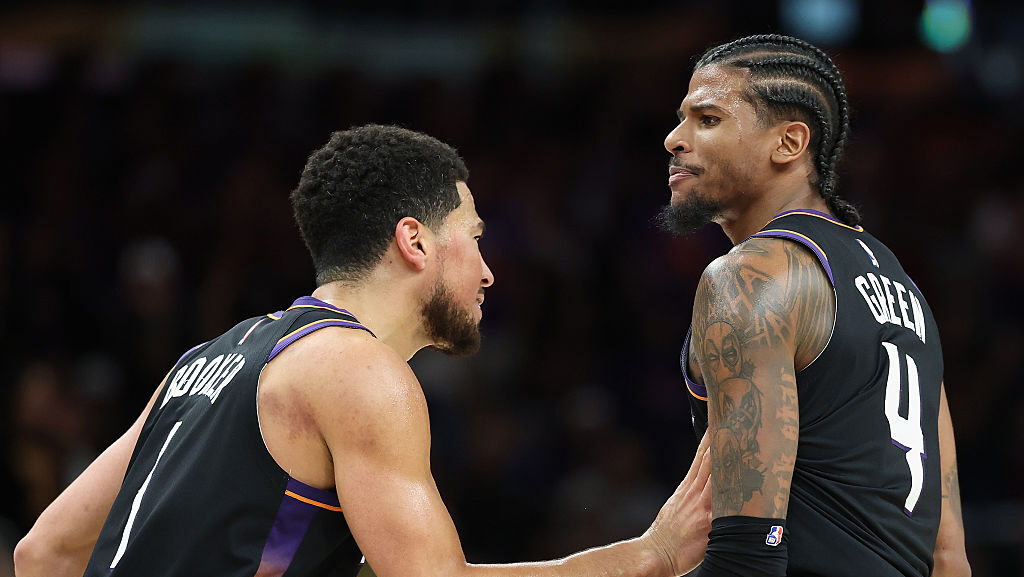
Jalen Green #4 of the Phoenix Suns reacts alongside Devin Booker #1 during the second half of an NBA play-in tournament game at Mortgage Matchup Center on April 17, 2026 in Phoenix, Arizona. The Suns defeated the Warriors 111-96. (Photo by Christian Petersen/Getty Images)
(Photo by Christian Petersen/Getty Images)
PHOENIX — Ever since the Phoenix Suns traded for Kevin Durant three years ago, they have not been able to pen in a reliable fifth starter.
From Josh Okogie to Grayson Allen to Tyus Jones to Ryan Dunn to Royce O’Neale to Bol Bol to Collin Gillespie to Jordan Goodwin, Phoenix has gone through three seasons of three cemented perimeter players — Durant, Devin Booker and Bradley Beal before Booker, Dillon Brooks and Jalen Green — while unable to find the right piece as the final fourth entrant.
Whether it was because of that specific thought or not, this is why the Suns gave up so much for Miles Bridges.
But it would have made a whole lot more sense for someone other than Bridges, because his inclusion is just going to get the Suns right back into this game of starting five musical chairs.
While each member of the foursome does more than just score the basketball, the best attribute each of Booker, Green, Brooks and Bridges provides is just that. So by default, Phoenix won’t be able to maximize the quartet. Instead, it’ll be asking the four of them to do more in those other areas. There were already fractions of this showing once the Suns’ trio got healthy together for the first time all year late into last season, and the cracks are about to intensify.
This lineup does not have enough shooting, defense, playmaking or rebounding to survive. It is a true laundry list to review what each player has to be better at in order to create a functioning unit, and the asks are simply too high.
Booker is a dozen years in now, so demanding a big jump out of him seems rather asinine. He is, however, the guy that can make this work. He’s far and away the best playmaker out of the bunch. The other three fail in many particulars of the craft, such as generating downhill pressure on the defense, knowing where that pressure is coming from and how to exploit that with where the passes will be available and making said passes.
Booker does this with remarkable consistency, and he should consider a late-career turn into a more direct style off the bounce by having his number one goal serve as getting into the teeth of the defense, instead of his usual read-and-react at a tepid pace. Part of the react comes with taking pull-up 3s, which defenses leave open for him more and more lately, and it might be time to leave those in the past. Booker has shot under league average from 3 in seven of the last eight seasons, and he was at a miserable 30.5% on off-the-dribble triples the last two years.
A huge problem, though, is how you get him to take less and generate more catch-and-shoot looks for him instead. How is he getting open off the ball and having it find him in this alignment? Booker took nearly twice as many pull-up 3s (239) as catch-and-shoot 3s (122) last year with the complete lack of playmaking help. It’s difficult to anticipate how that gets better this year.
While we won’t see the on-the-ball rise from him defensively that he teased in the postseason three years ago, Booker has to lock in off the ball. He was good for large patches of last year as an overall defender, but too many times he’d have mental lapses off the ball where he lost focus. It became more prominent in the back-half of the season when Phoenix’s defense went from elite to OK.
Even though Suns fans only saw 36 games of Green, they get the gist here. Green simply has to be consistent in all the parts of his game he shows potential for. A lot of it comes down to the decisions he makes with the ball. You can at times see him grappling with the choices. During a heater in Milwaukee, he nearly took a (bad) step-back 3 before passing it to a teammate and resetting, then getting downhill to set up an easy kickout 3 to Booker (on the catch!).
This decision by Green basically sums up the whole article. Nearly lets it go before making a great basketball play. https://t.co/FW4znardXL pic.twitter.com/m117jyriD1
— Kellan Olson (@KellanOlson) March 11, 2026
Sometimes, Green’s decisions seem predetermined. There are possessions where he is dead-set on getting his teammates the ball, forcing a pass through a window that is not open. Then, the wall that window is on could be blown open entirely and he will still take a slightly contested 20-footer. That’s fine when a player is young. And Green is still only 24 years old. But this is now Year 6 for him. Time to get that stuff down. His 1.26 assist-to-turnover ratio was way, way too low for how often he had the ball.
And it was an odd shooting season for him efficiency-wise. Green shot 50% on pull-up 2s, by far the best mark of his career. But what kept his field goal percentage in a similar range as it was in Houston, 42.2%, was a poor 60% knockdown rate at the rim, 36% mark in floater spots and career-worst 31.3% from deep. Building off those middies going down and getting the other numbers in check would suddenly turn Green into an efficient scorer.
The desire, of course, out of the most explosive athlete and dribbler on the team would be for Green to live at the rim. Last year, Green was at a 29% rim rate, an above average number for a guard that could get much better. The question is how Green will find the space to get to the basket, and how teams help off the shooters in the corner for this starting five. And when Green is in that corner, he has to get back to his solid catch-and-shoot numbers from Houston. It was a disappointing 34.3% last year.
The X-factors in making this work will be Brooks and Bridges.
Brooks put together a historic season in terms of how often he was using the ball and how little he was assisting his teammates. His usage percentage of 28.6% along with a 9.6% assist percentage made it the first time in 10 years anyone had a usage percentage of at least 28% with an assist percentage under 10%, per Stathead. Even more damning is it was 25 years since a perimeter player had done it.
This obviously wouldn’t have worked in a full season with Green healthy, and will require a major role change for Brooks. It was by far the largest his offensive responsibilities had been in his NBA career, and he loved it. Will Brooks not only be OK with less shots but move the ball more without it in his hands nearly as much?
He’s also got to get back on track as a shooter, which will have to include more restraint. Brooks took 40% of his 3s off the dribble, way too high of a mark, especially considering he shot 31.8% on them. He has had this type of volume in the past, like in his last season with Memphis when he made only 27.1% of his pull-up 3s that comprised 35% of his total triples.
How did Brooks see a major uptick in his 3-point percentage two seasons ago? Up to 39.7%? Well, he only jacked up 18% of his 3s off the dribble and hit a career-best 40.9% on his catch-and-shoot looks. He has to get back to that shot diet.
On the other end, Brooks has to be even better on defense than he was last year. He particularly thrived as a pest for certain star matchups he could get physical with, while his team defense elsewhere was more hit or miss, prone to lapses you wouldn’t expect from someone of his pedigree. On top of that, having him serve as the on-ball specialist would go a long way. Someone in this foursome is going to have to do it.
Bridges has to embrace the well-rounded game he touted when he was introduced as a member of the Suns. In an unprompted answer, he addressed the claim that he is a scorer first and only likes to score.
“People that don’t know me or probably seen me play with the Hornets they probably think that all I want to do is score, but I’m a willing passer,” Bridges said. “I want to get my teammates involved, want to get my bigs going, want to get all the guards going, get Book his points — I’m very excited.”
While he is the good passer that he says he is, Bridges has to set up that part of his game more often, looking to pass as much as possible when driving the basketball. With the skill he has as a playmaker, Bridges should be far better than a pedestrian 50th percentile in assist-to-usage ratio. He needs to be the true secondary playmaker he believes he is.
He also has to get to the rim more. Bridges’ floater volume has gone up in the last two years, an area of the floor where he should be using his elite athleticism to instead draw fouls and finish through defenders, or using that space to once more find his teammates.
And if your primary skill on offense is slashing and playmaking, then you have to get to the foul line. Bridges has taken 2.7 free throws per game over his career and his career high is 4.2. When looking at Bridges’ career high of 17.5 field goal attempts per game in the 2023-24 season, he was one of 27 players to take that many shots a night, and his 3.1 FTA/G were last out of those 27 players, according to Stathead.
GM Brian Gregory cited Bridges’ catch-and-shoot numbers as “exceptional,” which were at 35.9% the last two years, so it’s unclear what numbers he is referring to. Bridges has the worst catch-and-shoot profile of the four, definitively a bad shooter outside of five years ago when an outlier 40% mark of efficiency came through, but it’s not like he’s that far off from these other three dudes.
Since Bridges came into the league in 2018, there have been 104 players to take at least 2,000 3-pointers over that time. Bridges’ 3P% is 97th (33.8%) out of those 104 players. Green’s is 95th (33.9%), Booker’s is 91st (34.8%) and Brooks’ is 85th (35.3%).
Bridges on defense has ranged in his eight-year career from moderately impactful to not good, more consistently landing in the latter range. He will have to be the best he’s ever been at a 4 spot where defensive versatility is vital. And on the topic of his position, Bridges’ uninspiring rebounding numbers gotta go way up. He’s at 1.1 offensive rebounds per game over his career and that won’t fly with what head coach Jordan Ott wants in the possession game.
The Suns would be incredibly fortunate for half of these asks to come through. And this is before getting to the dilemma at center, where Oso Ighodaro became more and more preferred over Mark Williams as the season went on, plus the development of Khaman Maluach to consider on top of that.
The shooting is a huge problem. All four guys are flat-out bad 3-point shooters off the dribble, so that will already allow defenses to sit back on screening actions, and the helpers can be more aggressive with the mundane catch-and-shoot reputations too. The playmaking is where you can be the most optimistic, perhaps seeing a jump coming from both Green and Bridges, but true ball movement leading to attacks of recovering defenders and open 3s for good shooters will be up to Booker.
The defense is where the most optimism should be, since Ott took a team without much individual talent in that regard last year and turned it into a top-10 unit. With that said, you eventually need good-to-great on-ball guys and reliability off it. These four don’t have that. And the rebounding will be primarily on Bridges, with occasional help from the other three.
Ott will have options to balance out the skillsets better. Gillespie could add shooting and playmaking. Goodwin and Rasheer Fleming could add rebounding and on-ball defense. Luke Kennard could add shooting and, uh, shooting. Perhaps Koa Peat’s ability to strongly contribute in all those areas outside of shooting could give him a shot.
And it goes without saying that even if this lineup struggles, it ain’t out there for 48 minutes. The bench is going to thrive as a swimming-up-from-a-25-foot-plunge breath of fresh air to rejuvenate the style of play, and Ott is going to make sure it’s sprinkled into the game early and often.
The reserves can’t be a cure-all, though.
It will become apparent the longer the season goes on that a change will have to occur, and it will have to come at the cost of the ego of one of those five who hasn’t stopped starting in games once they got the go-ahead as young players. The bet would be on Green, Bridges or Williams.
Ott showed last year that he doesn’t mess around and will make the necessary changes to give his team the best chance to win. With the moves they made, his front office is going to force him to show that important trait at some point next season.
Related
 Suns exercise 4th-year option on Ryan Dunn, 3rd-year option on Khaman Maluach
 Luke Kennard has had to fit in with many teams, says Suns transition has been easy
 Suns defend Miles Bridges acquisition as owner reveals forward was top offseason target
 Devin Booker’s largest challenge of career comes this season
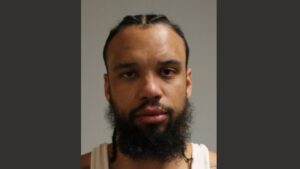 Dillon Brooks charged with DUI for March incident in Scottsdale
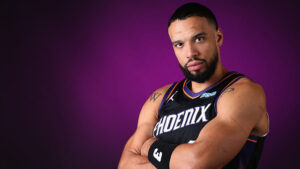 What did Dillon Brooks learn on an offseason trip to China?
Comments
10 Comments
I think KO gets paid by the word
Anyone who has one doesn't want Green for him.
KO can write a BLOG like nobody's business! The Suns should still try to move Green for a real point guard.