
Why is Devin Booker not a better shooter?
Devin Booker's 3-point numbers aren't great. But it's more complicated than saying he should cut down on the volume, especially on this Suns team.

Watch: Luke Kennard getting dinged up brings up a worry about the Suns' pull-up 3-point shooting | 50 mins
PHOENIX — It just doesn’t make any damn sense.
Devin Booker, the guy with arguably the prettiest jumper in the game of basketball today, is not a good shooter.
The No. 13 pick in the 2015 NBA Draft came out of Kentucky known for his high IQ, competitive motor and sharpshooting after making 41% of his 3s for the Wildcats. Since then, Booker has never reached 40% in the pros, rarely even coming close. His career number of 35.2% is a complete shocker every time you see it.
Booker, who has taken over 4,000 triples as a Sun, grades poorly over that time. Take the 137 players that have chucked at least 2,000 since Booker came into the league and his 3-point percentage ranks 116th. He has shot under league average seven of the last eight seasons.
Why is that? And is it something he can fix as he enters the next stage of his career?
It’s not so much that there is an obvious tweak to make with his 3-point shot as much as there is an obvious problem weighing it down.
The 3-point (r)evolution
To be clear, Booker is a good shooter in the most traditional sense.
Watch him take set shots or catch-and-shoot looks and you’ll see a rhythm few can match. Seeing him warm up before a Team USA exhibition alongside Stephen Curry felt like a moment of the greatest shooter ever being joined by a true peer. I’m sure Curry would agree with that sentiment.
In his 11-year career, Booker has a 3-point percentage of 39.1% on catch-and-shoot 3s. See, good shooter.
But that’s not what determines a good shooter in the NBA anymore, at least not for players of his caliber.
The simple thing to understand is that Booker’s numbers get tanked by his pull-up 3s, otherwise known as a triple taken after someone dribbles, as opposed to catching and shooting without dribbling. In a ball-screen league, it’s a game-changing shot. It’s also a crucial part of NBA stardom he has not cracked and likely never will.
Booker has, more often than not, lagged behind with his knockdown rate on these, especially in the last few years.
Before we get to those numbers, a clarification: pull-up 3s will be our sole focus today, so it’s important to establish how we got to this point where 3-point shooting is multi-faceted in this way.
Within the 3-point revolution was the next step: how to take more volume of 3s to expand the space on the floor for the defense to cover. The evolution inside the revolution, if you will.
The leaders of this charge arrived in Curry and Damian Lillard. It was not only the deep range on their jumpers, but how they could take them off the dribble, too.
When Booker came in the league in 2015, it was Curry, Lillard and James Harden who were the only three players to jack up at least four pull-up 3-pointers a game. Last year? Fifteen guys did it.
“They open up the floor. Those guys, they changed the game with that shot,” Booker told Arizona Sports. “It’s obviously something that I’ve been working (on) that I never relied on (previously) and tried to implement in my game.”
To pause for a brief disclaimer, you’re about to get hammered with two metrics pretty routinely while reading — the amount of pull-up 3s per game a player takes (PU3PA/G), and their shooting percentage on them. All of this is to create an understanding of how many Booker is taking and how bad he is at shooting them. Then I’ll elaborate on whether he should take fewer of them.
So, to go back to the 2015-16 season, if Steph’s 6.4 PU3PA/G were crazy back then, how about Luka Doncic getting up 8.4 three seasons ago or again hitting 7.5 last year, like Anthony Edwards did two seasons ago?
Harden took it too far in the experimental phase, chucking a ridiculous 12.1 PU3PA/G in 2018-19. He even more ridiculously still made 36.1% of ’em.
All perimeter scorers are attempting to develop this skill. To include non-stars, a figure like 2.5 a game was done by just 14 players in that 2015-16 campaign. Last year it was 46 ball-handlers taking that decent-ish volume off the bounce from deep. The evolution is well underway.
It’s easy for even a novice basketball fan to think about how this has changed the way you have to play team defense. Ten years ago, from the perspective of defending a shooting threat, defenders could go under a screen and the big in the anchoring position could stay further back in a drop coverage. There was little to no worry about that small window resulting in a shot the defense would worry about, unless it was one of those innovators.
Now, though? There are plenty of guys to fight through screens for, and also for a big to meet at the level of the screen — in order to cut off any chance of a semi-open 3-pointer going up. If that big has to go high up, that means the backside could be compromised, so now an extra help defender essentially becomes a key part of the possession, having to cheat over a certain amount from their man hovering atop the arc on the weak side.
Thus, the geometry has completely changed.
Utah Jazz head coach Will Hardy offered the coach’s perspective on what changes for a modern defensive gameplan now because of the pull-up 3.
And his first thought wasn’t even that space around a ball screen. It’s way before that.
One of the trends within this trend is what’s referred to as a “pickup point,” which is exactly what you think it is. Does a defender take someone like Curry and get him full-court? Ideally, yes, but he is certainly a guy who has one of the deepest pickup points in the league, rarely being allowed to cross half-court without a guy tucked into his space. These are getting more and more aggressive by the year in the 2020s.
“The point of attack defensively has changed a lot,” Hardy said. “Pickup points are a huge conversation in relatively every coaches meeting that I’m in as it relates to gameplans — the first argument is where we’re going to pick the ball up.”
The balance is how that over-aggression can work against on-ball defenders, as well as wear them out through the course of a game and a season.
Hardy nailed it when he extended on his point.
“The skill level in our league has never been higher. … I do think a lot of the decision-making defensively is how you’re willing to lose,” Hardy said. “We don’t wanna necessarily think like that, but you can’t take everything away in our game now.”
The Jazz and Hardy have a young guard duo that could become special in many ways, including with these triples off the bounce. Fourth-year guard Keyonte George still has room to grow on a shot he’s trying to improve at, while rookie Darryn Peterson has all the tools to be one of the best at pulling up from deep.
But even if George’s efficiency is kinda blah again and Peterson struggles to knock ’em down, Hardy wants them to shoot pull-up 3s anyway because opposing defenses have to at least consider those shots now. As he pointed out, the threat of a pull-up in turn actually opens up the better version of a 3, with higher up pressure leading to downhill drives and ball movement for catch-and-shoot looks.
“It just puts the defense on their heels, makes them stretch out, be up further and I think it opens up more driving lanes,” Booker added of the benefits.
San Antonio Spurs head coach Mitch Johnson referred to how different the “coverage map” now is.
Therein lies the intricate beauty of basketball, a sport that will keep changing and evolving despite how simplistic its base rules are, with a limited amount of room on the floor for only 10 guys out there.
It’s also ruthless in that ever-evolving form. Adapt or die.
Booker loves and appreciates that beauty more than most, so he’s sure as hell trying to adapt.
Right now, he’s fighting through some failures while doing that.
Pulling back on pulling up
Booker’s been remarkably consistent about his volume on pull-up 3s. He’s been somewhere between 3-4 a game for a decade and sticking a smidge below four the last few years, which ranks him inside the top-20 league-wide. Again, the threat of that is valuable, and it serves as a way for him to take more 3s.
A few years ago, the desire was for Booker to get his 3-point volume up. Look across the NBA right now at the best scorers in the league, and you’ll see almost every name checking the box while taking a lot of 3s off the dribble. This is an easy hack toward going from five or six attempts from deep a night to hovering around double digits. In turn, it takes a 23-26 PPG guy and elevates him near or through the threshold of 30 PPG.
Booker’s career-high of 7.3 3PA/G from the 2024-25 season is a plateau of seven he’s reached only two other times.
It would be surprising to see him crack it ever again, due to the pull-up game proving unsolvable for him.
The hope for the percentage on off-the-dribble 3s, especially from a top-scoring option, is to be in the mid-to-high 30s. An open pull-up compared to an open catch-and-shoot look is much higher on the degree of difficulty scale, and oftentimes, these shots come in tight spaces. A few ticks below that is even tolerable depending on the level of threat the ball-handler is putting on the defense with that pull-up.
Booker has rarely done that in his career. In fact, most seasons he ranks near the bottom of the league.
Below is the NBA’s tracking data on Booker’s pull-up 3s across his 11 seasons.
Devin Booker’s pull-up 3-point accuracy by year
2015-16: 23.2% 1.3 PU3PA/G
2016-17: 32.8%, 1.7 PU3PA/G
2017-18: 36%, 3.7 PU3PA/G
2018-19: 29.1%, 3.7 PU3PA?G
2019-20: 33.8%, 3.3 PU3PA/G
2020-21: 30.8%, 2.8 PU3PA/G
2021-22: 35.7%, 3.8 PU3PA/G
2022-23: 30.9%, 3.8 PU3PA/G
2023-24: 36.2%, 3.9 PU3PA/G
2024-25: 30.3%, 4.0 PU3PA/G
2025-26: 30.4% 3.8 PU3PA/G
OK, so not great. It’s much worse, though, in the context of where other high-level scorers lie.
Booker was 16th in the NBA last year on his volume with those shots. Instead of listing even more numbers, how about a visual aid? May I interest you in a poorly made dot chart by an amateur in that department? Wonderful!
The dots represent those 16 shooters, and without the labels, the only thing I really need you to see is where Booker is: that orange dot on the bottom left with the worst 3-point percentage (30.4%) among the players that took as many as Booker did a night (3.8).
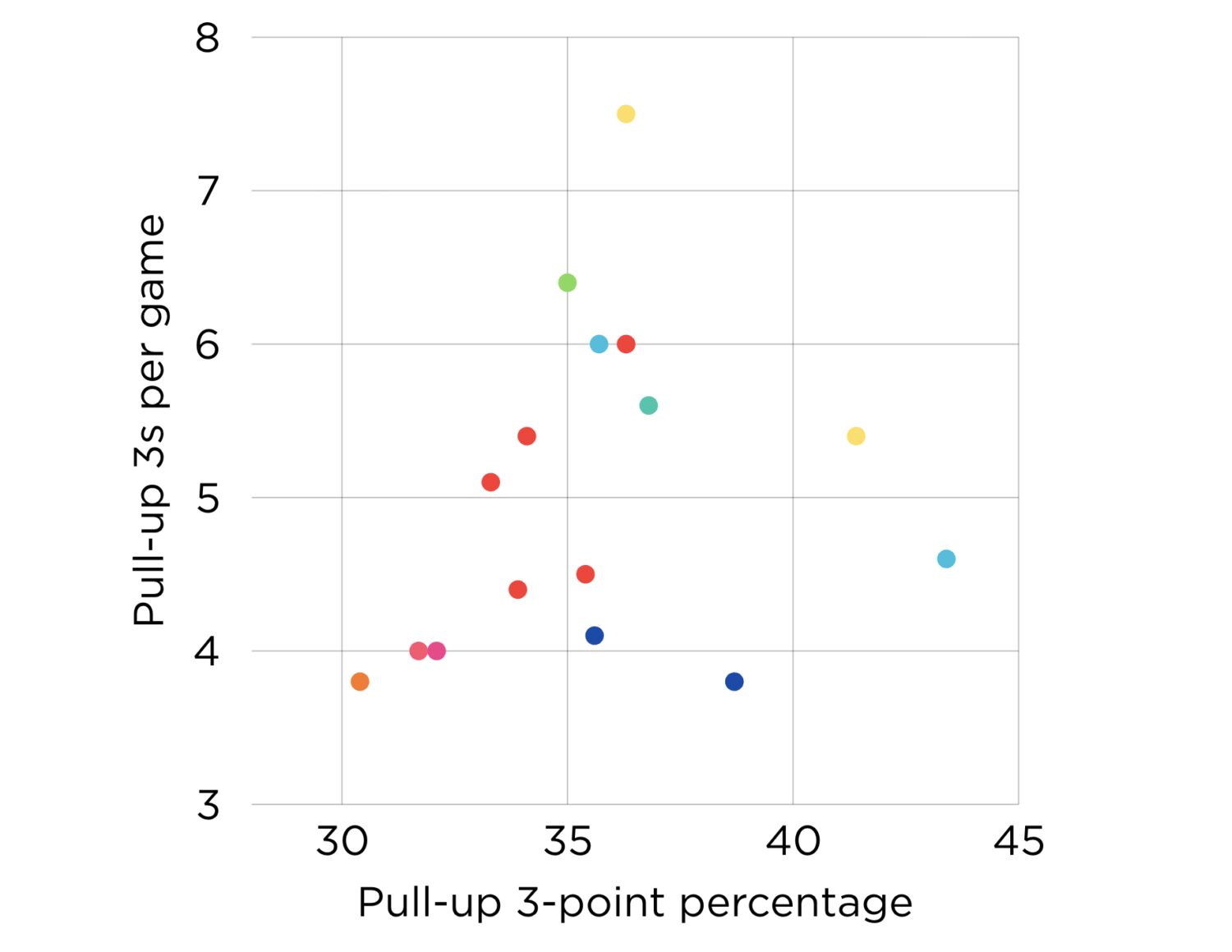
We’ve got the Curry and Jamal Murray grouping past 40% on the right side of the chart and Doncic’s insane volume up top, while most of the premium pull-up artists are fluttering between that percentage range of the mid-to-high 30s we talked about. That’s Harden (36.3%), Edwards (36.7%) and LaMelo Ball (36.8%), with some a shade lower like Donovan Mitchell (34.1%) and Tyrese Maxey (33.3%).
Booker joins Derrick White (32.1%) and Trae Young (31.7% in 15 games) as the guys in that questionable efficiency range.
To look at Booker’s number from two seasons ago, 30.3% on an even four a night, here are the only percentages worse on that much volume in the last 10 years: Jayson Tatum in 2022-23 (29.1%, 4.8 PU3PA/G) and Shai Gilgeous-Alexander in 2021-22 (27.3%, 4.4 PU3PA/G).
Tatum is on that chart above: the Celtic green dot was second in the league in pull-up 3-point rate while shooting it at 35%. He tends to get stuck in the low-to-mid 30s, while SGA interestingly turned down his volume for two years after that disaster before his last two seasons were much more efficient on good volume — a jump to 4.7 PU3PA/G two seasons ago saw great returns on 36.1% shooting, and it was 38.8% on 3.5 PU3PA/G last year.
These knockdown rates tend to fluctuate, but the trend you see is a few tiers that we inadvertently already covered. The greats can touch the high 30s and even go beyond that into the 40s, while solid footing is keeping it in the mid 30s. Some of those guys will dip down in an off year to the low 30s, a range Maxey hopes to grow out of at 25 years old while Young has firmly been entrenched there for the last handful of years.
Booker, however, has definitively been the worst on this type of volume over the past four seasons.
He does not have an answer for why, but in the brief conversation Booker had with Arizona Sports on it, he made it clear they are still going up.
“I don’t know,” Booker said of the low percentages. “I’m gonna keep shooting ’em, though.”
On the flip side, Booker also produced three other seasons in which the numbers were in a more than satisfactory spot, yielding all the benefits for spacing we talked about.
It’s not like he’s completely lost it. Right? Or is it time for him to pull back on pulling up?
What makes that question difficult to answer is the team he’s on.
Will the Suns get by on bad efficiency with pull-up 3s?
The Suns had five players last year on decent volume with pull-up 3s.
Only Collin Gillespie, (35.2%, 3.5 PU3PA/G) had good efficiency.
Grayson Allen (29.1%, 3.7 PU3PA/G), Jalen Green (29.2%, 3.5 PU3PA/G) and Dillon Brooks (32%, 2.6 PU3PA/G) were all either just as bad as Booker or worse.
Allen is now gone, Green struggles nearly as much as Booker does to convert on them and this was the first year of Brooks’ career when he was letting ’em fly at that high of a rate.
Miles Bridges is smaller on volume, but if there was anyone that should not take them this year, it’s him. His last four seasons: 25.2% on 1.5 PU3PA/G, 24.6% on 2.9 PU3PA/G, 29.1% on 2.2 PU3PA/G and 28% on 2.0 PU3PA/G.
This is noteworthy because, for reasons we will get to in a minute, Phoenix really needs another guy that can knock these down. It ain’t him.
Phoenix as a team interestingly shares a direct parallel with Booker.
The Suns were shockingly tied with the Boston Celtics for the most pull-up 3s per game last year, 14.8. If you know the Celtics at all, that is crazy to be in their atmosphere, as Boston launches with reckless abandon from deep in all aspects. The third-place teams were all the way down at 13.3 a night.
The Suns as a team shot 31.9% on those, 19th in the league. That’s not so bad, but only two teams ranked below them took double-digit attempts per night, and that speaks to how the squads lacking in shooting talent knew their limits.
A team full of bad pull-up shooters does not mean opponents will exclusively play lax ball-screen defense. They will still send trapping and hedging with some aggression.
But the Suns are going to make that choice much more of a luxury than a predicament with this shooting talent.
Let’s take a look at how Booker’s 3-point attempts off the dribble in the halfcourt shaped up in the postseason.
A huge asterisk here is that these are only the attempts. This isn’t a total representation of how teams defend Booker in ball screens. He gets everything thrown at him, and a good amount of the time, the design is to get the ball out of his hands. We do see teams, though, growing more and more OK with letting him shoot more now in the last few years.
That is an issue.
The Portland Trail Blazers, with a center like Donovan Clingan who prefers to be in a drop, were able to play their preferred look.
The Golden State Warriors were higher up with how often they switch, but were mostly committed to that couple of feet of space where they can get a half-decent contest up if Booker shoots it, while giving him enough room if he wants to let it go.
The Oklahoma City Thunder found that perfect middle ground (as always) of making Booker feel the big’s presence while also not spending the majority of possessions committing, with an all-out trap. At times, Isaiah Hartenstein did stay all the way back, which was telling.
Again, that’s effectively a double-team Booker is seeing in most of those. And you almost never watch Booker turn a screen and decline to shoot when the space is there.
“Whenever the big is back,” Booker said of when he wants to get them up. “I’m going to keep shooting it. I have a gauge on the game, and I trust the work.”
It’s more about how teams can get away with giving him that space if they want to, and opponents now sometimes do.
Half of the pull-up 3s from the postseason are not in those videos. That’s because they come in transition or semi-transition, which is when Booker really wants to get them off the most.
“Just take the ones you can get,” head coach Jordan Ott said of it. “A lot of times in transition is finally when he has someone off of his body.”
That actually brings up a great thought, coach. How many of those without a strong contest from a defender is he taking? And do they go in more than the ones in the half-court?
Slow it down
The NBA’s stats page with video only categorized 215 of the 240 pull-up 3s taken by Booker last year, but it’s still a healthy enough sampling to log through and see how often he’s taking them outside the half-court. So, as any sane person with extra free time does, I went through and logged all 215.
What I deemed as “semi-transition” is when any defensive player was still back-pedaling or jogging back into the play as Booker was looking to shoot, thus making it impossible to clearly define the defense as “set.” Ditto for an offensive player not being in their spot yet either. The effort, more so, was to track early-clock 3s.
The results? First of all, the volume was a surprise.
Out of those 215, I counted 105 that were what I would deem as semi-transition or quicker. That is 49% of them. A large chunk of these are a very high ball screen from the center around the logo, with Booker turning the corner and pulling from the top of the key. For those who watch every night, yes, some of those include the dreaded 2-for-1s it seems like Booker never makes.
On those 105 quick pull-up 3s, he made 29. That’s 27.6%, even lower than his 30.4% overall on pull-up 3s. Do the math yourself for the half-court attempts and that means he’s around 34% on those, which is a more manageable rate and another shocker.
Thus, the conclusion here would be if there is anywhere for Booker to stop taking them, it’s actually in those situations when he’s the most open.
The early-clock 3s, and especially those in real transition when all five defenders aren’t back yet, I would categorize as “bad shots.” There are opportunities elsewhere to get the ball moving and/or get to the paint. Based on the numbers, that’s a better choice. Then again, the misses do help in a way.
“Even just taking the shot sometimes and not making it,” Booker said of what the pull-up 3s do for the offense. “I don’t think any team’s gameplan is to leave me open.”
Over half of them are Booker utilizing his phenomenal footwork and shooting form by jacking it up while still either in a full sprint or moving fast up the floor, and despite the “teach it like this” level of mechanics, they don’t go in enough. So they should probably stop going up.
Ott pointed out how a lot of these at home are momentum swings that the Suns feel can be a big boost in the middle of games.
He was asked if he finds it odd that a shooter of Booker’s pedigree struggles so much with this shot.
He reiterated he wants Booker to keep shooting them.
“I just think the game evolves and there’s a variance of it all. There’s some dips in everybody,” Ott said. “But if he sees the rim, go ahead and let it go.”
Push and pull of volume and efficiency
That’s the largest problem. The other decent-sized one is if Booker launches fewer of them for the sake of getting the best shot each possession (and the others on the team follow suit), Phoenix’s 3-point rate will dwindle. It ended last year 17th in the percentage of its shots that were from 3, which is lower than you’d think based on what the eye test told you of how much the Suns were at times forcing them up. They’ll be lucky to avoid the bottom-10 this year.
Allen was the clear example of this. He quadrupled his pull-up rate on 3s, going from 0.9 a night under Mike Budenholzer to 3.7 under Ott. His efficiency showed how tough that adjustment was for him — a shooter of his caliber would have figured it out eventually.
To some extent, Booker and Green just got to let them rip still, and the Suns just have to hope the hard work that duo puts in will result in better marks than normal.
Gillespie, the only good shooter in this regard last year, has to get up even more after 3.5 PU3PA/G. That was a fantastic result, and it might sound greedy to want an uptick, but he’s the best volume shooter on the team by a landslide.
Here is what he said when asked how he felt about his volume last season.
“I mean, I was happy with it,” Gillespie correctly stated. “I think I got a good amount up. But it was really just reading what the defense was giving us.”
Gillespie said that when he was starting, he noticed less drop coverage giving him those looks with space. Playing off the bench, if that trend continues into this season, could get him better opportunities.
He also noted it’s really just a read-and-react as the game goes on, and if you’ve watched him play before, you’ll see he and Oso Ighodaro find their spaces for pitch-and-catch quick-hitting actions to get him those 3s on the move.
Free-agent signing Luke Kennard is the other shooting piece on the roster. Kennard, however, is notoriously the best 3P% player in the league since he got into it primarily because he does so on low volume. For pull-ups, it’s even lower. He took 45 in 78 games.
It’ll be on Booker, Gillespie and Green to carry the volume and the efficiency.
Shooters shoot?
To conclude, should Booker take fewer of these shots to be more efficient?
Probably not?
It’s not the clean satisfaction of an answer you desired after perusing through this deep-dive, but we’re working with a lot of gray here.
For what it’s worth, Hardy himself didn’t have it on the entire equation, either.
“It’s a great question because if I had a perfect answer I’d be better at coaching than I am,” he said on how to defend pull-up 3s. “It’s a hard one.”
Booker is one of the worst pull-up 3-point shooters in the NBA when you group him into the few handfuls of guys that take them on fairly high volume. That should make it easy enough to assign a decrease, especially on the early-clock 3s we reviewed.
The cause-and-effect gets dicey, though.
This would lower Phoenix’s 3-point volume, handing the Suns an automatic disadvantage in the math game they handled beautifully last season. It would also let defenses off the hook, conceding those few feet on the floor Booker can still force defenders to occupy in case he rises and fires. And as Hardy talked about earlier, now it’s one less thing for opposing defenses to worry about with the guy that always gets top billing on the scouting report.
Booker himself mostly uses these looks to get a clean one off after not seeing one for a while, since finding an in-rhythm jumper inside the 3-point line is a jungle maze he has to hack and slash through every night. This could further jeopardize the rhythm of the guy who plays with infamous flow.
Most of all, telling Booker to shoot less, even in this smaller fashion, seems absolutely insane given how he’s going to have problems again this year with getting the proper amount of shots up a game playing alongside shoot-first scorers.
For now at least, the best answer is for him to keep shooting.
Related
 Suns waive 2-way guard Koby Brea, forward CJ Huntley
 Oso Ighodaro reportedly agrees to 3-year contract extension with Suns
 The Athletic ranks 1 Suns position as top 10 in the NBA
 Kevin Durant takes shot at Suns owner Mat Ishbia on X
 Suns keep Jamaree Bouyea as 14th player, cut Haywood Highsmith
 Suns end preseason with offensive pros, cons flashing vs. Jazz
Comments
1 Comments
You needed this long article to know why he isnt a good 3 point shooter? Thats simple, he isnt a dribble 3 point shooter. He is a spot 3 point shooter. Now he can drive to the free throw line area and bully his way to a short jump shot and be good with that. But he is a shooting guard where he should be moving off the ball, getting to his spot and just pitch and shoot. That is his game.