
Arizona State’s offense was all over the map in first 3 games. What did we learn?
Quarterback Cutter Boley was always going to determine the floor and ceiling of ASU this season, and he's shown the whole spectrum so far.

Watch: How does Dillingham evaluate Cutter Boley's performance through 3 games? | 44 seconds
Arizona State football was in danger of disaster in England, but it pieced together a win over Kansas to start Big 12 play and enter its lone bye week of the season at 2-1.
The Sun Devils were not only all over the map geographically — playing games in Tempe, College Station and London — but also in quality. They blew out an FCS opponent, kept it close at Texas A&M before collapsing in the fourth quarter and managed a sloppy win against Kansas.
The logistical nightmare of the international trip straight from Texas is behind ASU, but the rest of the Big 12 schedule is still among the toughest in the conference, including road games at No. 9 BYU, No. 11 Texas Tech and Arizona, along with the cross-country trip to UCF.
ASU’s offense has fallen short of expectations over its last five quarters, so we’ll break down that unit before doing the same with defense and special teams later in the bye week:
Assessing ASU football at bye week 3 games in: Offense
Quarterback Cutter Boley was always going to determine the floor and ceiling of ASU this season, and he’s shown the whole spectrum so far.
He looked exactly how he should against Morgan State, showed real poise at Texas A&M before two fourth-quarter interceptions that were taken back for scores and had what can only be described as a poor showing in London against Kansas.
“I think he’s played well. I think he’s taken care of the football. He doesn’t have — knock on wood — like I’d call it a real interception,” head coach Kenny Dillingham said. “He hasn’t thrown the ball to the opponent one time in three games and that usually results in winning. His completion percentage is somewhere (around) where we need it to be.
“But we still have to get the ball downfield more. We have to get the intermediate passing game going. A lot of that’s on me; I’m not calling it for a variety of reasons … but eventually, we’re going to need that to rock and I think he’ll flourish when we start doing that a little bit more.”
Boley was uncharacteristically inaccurate not only downfield but also on some check-down throws his last time out. His anticipation for where receivers will be and when to get the ball out lagging behind, however, was less uncharacteristic.
ASU had the option to try Mikey Keene or even Jake Fette at points, but Boley’s touchdown to Reed Harris to end the first half and his rush to convert a third down on a scramble to get the play off that sealed the win seemed to buy him some slack on the leash.
all-22 of cutter boley's 23 throws vs. kansas, plus his rush that sealed the win.
made enough plays to get it over the finish line, but plenty of inaccuracy and needs better anticipation with the caveat of the logistics and rain. also two angles of a big no-no-yes play he made: pic.twitter.com/MDjzEUZzML
— Damon Allred (@iamdamonallred) September 22, 2026
As Dillingham pointed out, Boley hasn’t been the turnover machine that many feared he would be coming from Kentucky with 12 interceptions in 10 starts last season. While no game’s outcome cares about whose fault a turnover is, it’s easy to make the case his turnovers haven’t been because of his decisions.
Either way, he needs to have a better performance next week against Baylor, or ASU could view the following game against Hawaii as a chance to integrate a new signal-caller.
Each of the starting offensive tackles, Luke Baklenko on the left and Jalen Klemm on the right, have gotten beat on a play that led to a Boley turnover. That’s likely the position of most concern across the board.
While the interior of the line has been much more effective, it saw its second right guard go down Saturday in Rob Lapuaho after starter Wade Helton was ruled out for a few weeks ahead of the contest.
Helton is in danger of missing the Baylor and Hawaii games, while Dillingham indicated Lapuaho will be available after the “much-needed” bye.
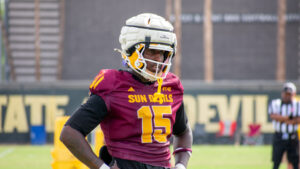
Tight end Khamari Anderson suffered a lower left leg injury against Kansas that will end his season, Dillingham confirmed, which won’t do the offensive line any favors.
Anderson has been graded as the fourth-best pass blocker among 18 Big 12 tight ends with at least 10 pass-blocking snaps, per PFF. The other tight ends behind him have struggled, including James Giggey, who had two penalties in the first 20 minutes of the game.
As for the skill positions, everyone has seen what wide receiver Reed Harris can do; he remains the Big 12 leader in receiving yards (374) and touchdowns (five) through three games. But his highly touted counterpart in the transfer portal, Omarion Miller, has yet to be fully unlocked.
Miller’s hyper-utilization in the screen game has his average depth of target (ADOT) at 3.9, lowest among the 11 Big 12 receivers with at least 20 targets, per PFF. When he led the conference in yards per catch (18.0) at Colorado last season, his ADOT was 14.2, which would rank fourth this season.
Dillingham said that stat is skewed by the amount of screens called in the Morgan State game and that more downfield looks were in the game plan against Kansas, they just couldn’t execute.
asu hasn’t been able to get the full value out of omarion miller yet, whose average depth of target (3.9) is more than 10 yards below 2025 and about half the next lowest big 12 receiver with real usage
kenny dillingham says they tried to change that vs. kansas but rhythm was off pic.twitter.com/GBAGipL32F
— Damon Allred (@iamdamonallred) September 22, 2026
Harris and Miller notably account for 39 of the 46 catches by wide receivers so far. Raiden Vines-Bright, Jalen Moss and Cory Butler Jr. each have two while Jaren Hamilton has one.
Following two seasons with a top-three rusher in the Big 12 (Cam Skattebo third in 2024, Raleek Brown second in 2025), primary running back Kyson Brown is 10th so far in 2026. As a team, the Sun Devils are 13th in rushing yards per game after they were second in 2025 and fourth in 2024.
Brown has been heavily featured, contrary to preseason talk of going running back by committee, as he has more than half of the running back carries (43 of 78). Marquis Gillis has the next-most carries among running backs, about one-fourth of Brown’s (11).
Brown’s 5.2 yards per carry rank 13th among Big 12 running backs with at least 20 rushes, while Gillis has averaged 6.6. Younger backs Jason Brown Jr. (12.0) and Demarius “Man Man” Robinson (6.8) have also been higher, albeit on smaller sample sizes of five and four rushes, respectively.
Dillingham said a personnel shift in the run game is coming, and it may be time to give Brown Jr. and Robinson a bigger shot.
Related
 Start times announced for Arizona State, Arizona’s Week 5 games
 ASU’s Jaren Hamilton, Arizona’s Noah Fifita honored among Big 12 Players of the Week
 Jayden Daniels dislocates left elbow for second time in less than a year
 ASU TE Khamari Anderson out for season after injuring left lower leg vs. Kansas
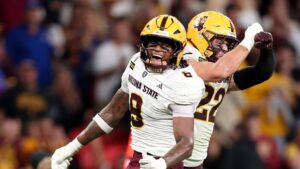 DL Hyrum Vaeono’s 77-yard fumble return helps ASU put sloppy win over Kansas on ice
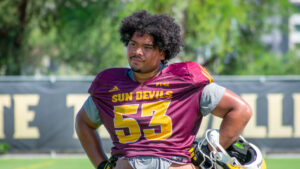 ASU RG Rob Lapuaho exits Kansas game while already without starting RG Wade Helton

Comments
1 Comments
"Either way, he needs to have a better performance next week against Baylor, or ASU could view the following game against Hawaii as a chance to integrate a new signal-caller."
I said four days ago that if "Cutter" doesn't cut it against Baylor, coach Dilly needs to look to Keene. Or maybe even Fette.