
Arizona’s NCAA Tournament draw includes early ease, major threats later
How tough is the NCAA Tournament draw for Arizona to make its first Final Four in a quarter-century? A preview of the West Region.

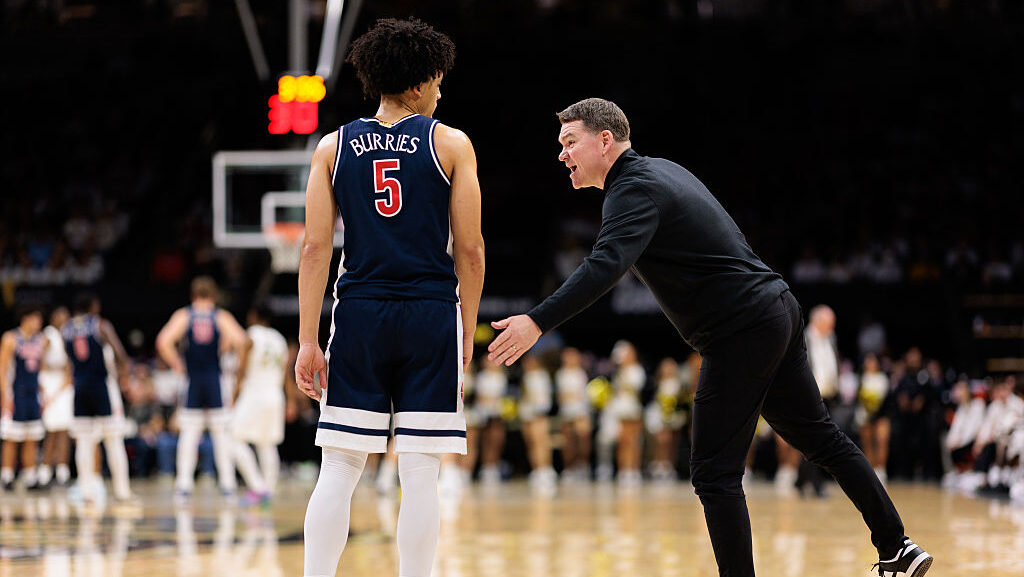
Head coach Tommy Lloyd of the Arizona Wildcats talks with Brayden Burries #5 during the first half against the Colorado Buffaloes at the CU Events Center on March 07, 2026 in Boulder, Colorado. (Photo by Andrew Wevers/Getty Images)
(Photo by Andrew Wevers/Getty Images)
Welcome back! After previewing as elite of an Arizona team as we’ve seen in recent memory and some matchups that could be a bugaboo on Selection Sunday, we have an NCAA Tournament bracket to dive into.
The biggest news on Sunday for Arizona, though, wouldn’t be that. It would be the Wildcats’ internal day-after medical review following a Big 12 Tournament championship.
Senior point guard Jaden Bradley injured his left wrist and had to go back to the locker room for X-rays that checked out negative, while freshman shooting guard Brayden Burries was seen with a heating pad on his left quad and calf on Friday. Burries said on Saturday he was also suffering from a “sickness and stuff.”
Bradley seemed to be playing fine on the taped-up hand. Head coach Tommy Lloyd didn’t offer up much information postgame, and even with the inclusion of Big 12 injury reports, information is scarcely offered up regarding collegiate injuries. Do not expect that to change with the tourney.
Burries didn’t make a shot on Friday and airballed his first two (wide-open) attempts from 3 on Saturday that indicated something wasn’t right. He did find a rhythm later in the game, all while taking a fall in the mid-second half that looked like a guy re-aggravating something. Burries is known to grind through ailments, with an illness that sidelined plenty across the country not being enough to keep him out earlier in the season.
Needless to say, the next few days will be of vital importance for Arizona to get its starting backcourt healthier. An optimistic thought would be both injuries are more soreness and irritation than anything, so a week-and-a-half stretch with only two games before the Sweet 16 begins in San Jose could be enough recovery time for both.
But how big of a threat are Arizona’s opposition in getting there, and how do the matchups potentially line up in the West Region’s second weekend to reach that elusive Final Four? Let’s discuss!
Arizona with calm path to Sweet 16?
No red flags for a first-round disaster. Sixteenth-seeded Long Island looks like a fairly spotless matchup. KenPom places the Sharks 239th in offense and 186th in defense. They are outside the top-200 offensively in rebounds and assists per game. Most notably, Long Island is directly ahead of Arizona in 3-point attempts per game at a woeful 16.5. It plays four players 30 minutes a night or more, and none are taller than 6-foot-5 or heavier than 215 pounds. This should be a breeze for the Wildcats.
For round two, eighth-seeded Villanova and ninth-seeded Utah State are both well-rounded. KenPom has both offensive and defensive units in the top-45. Does either squad match up physically? Not necessarily.
Both are outside the top-125 in rebounding margin, with Utah State sitting 146th (+1.4). The Aggies’ bread and butter is efficient playmaking in the possession battle to help make up for that. They are 17th in assists per game (17.6) and 90th in turnovers per game (10.6), which is further boosted by being top-30 in forcing opposing giveaways as well. Utah State doesn’t offer much from 3 or at the foul line, so it would have issues making up for how undersized it would be. Its defensive rebounding metrics are concerning. Arizona’s frontcourt would likely have its way.
Villanova can at least get up the triples. The other Wildcats are 45th in 3s per game (27.3) and shoot it on an OK number (35.3%). They’ve been more consistent with their volume than explosive. Villanova has broken 15 made 3s just twice, instead making 8-to-12 triples in 17 of its 32 games. Former Sun Devil Duke Brennan at 6-foot-10 has been a tremendous rebounder, grabbing 10.3 a night, a. top-15 mark nationwide. Brennan is one of three All-Big East nods on the squad, joining junior guard Tyler Perkins and freshman Acaden Lewis.
The most damning note on both potential second-round opponents is neither has a win over a ranked team. Villanova went 0-5 and got boat-raced by Michigan (28-point loss) and St. John’s (32-point loss). Utah State didn’t get the chance to face one, but in terms of more quality opponents, it went 4-4 in Quad 1 games. Villanova was 2-6. Yeesh.
All said, Arizona couldn’t have done much better in the layout of the first weekend. On paper, it avoids any major counters with physicality or 3s. With respect to Utah State’s great duo of senior guard MJ Collins Jr. and junior guard Mason Falslev, the talent doesn’t forecast star-making outings that could outdo Arizona’s unmatchable balance, either.
But, uh, speaking of star power.
Individual firepower could await Wildcats in San Jose
If Arizona makes it to the second weekend and the Sweet 16 in San Jose, an electric matchup is in the cards, one way or the other. I’d go as far as saying it’s a tougher game than what could be there in the Elite Eight.
A chalky route would produce either No. 4 seed Arkansas or fifth-seeded Wisconsin, two extremely battle-tested teams that have been there and done that with elite opponents. Six of Arkansas’ eight losses came to a team with a number next to its name, while it beat Louisville, Texas Tech, Tennessee and Vanderbilt twice. Wisconsin has been more hot and cold, with bad losses to USC and Oregon getting outweighed by upsets over Michigan, Michigan State and two victories over Illinois.
Arkansas is led by probable top-10 pick Darius Acuff Jr., a freshman sensation that would be the talk of the sport if this wasn’t the most loaded class in decades. Acuff, a dazzling lead guard to watch, has scored at least 17 points in 27 straight games and on the season has reached 25-plus on 10 different occasions. He’s a three-level scorer (22.7 PPG, 48.7 FG%), pull-up threat from anywhere (5.7 3PA/G, 43.7 3P%) and awesome playmaker (6.3 APG). Acuff is flat-out one of the most dangerous players in the tournament and the best player in the West region.
The Razorbacks have the sixth-best offense in the country, per KenPom. A lot of that is Acuff, plus a top-10 turnover number as a team, and that’s hard to believe with a freshman as the head of the snake. Don’t let the 3-point volume sitting outside the top-200 fool you — Acuff is joined by freshman guard Meleek Thomas, who shot 42.5% from deep on 179 tries, four less than Acuff. That duo and springy senior forward Trevon Brazile are a problem. Arizona’s big advantage will be on the other end, where Arkansas’ poor interior defense and rebounding would create an area of the floor the Wildcats would have to dominate (and should).
Wisconsin is an enigma, a wild statement considering the previous team is led by two freshmen guards and the Badgers’ star pair has had far, far more life experience to speak to. But junior guard John Blackwell and senior guard Nick Boyd (who will turn 25 years old in April) have exploded in those aforementioned gigantic wins. Their most recent work was a combined 69 points in a quarterfinals win versus Illinois in the Big Ten Tournament. When Blackwell scores 25-plus, the Badgers are 8-1. It’s a 7-1 mark when Boyd does it. When Blackwell fails to crack 15 points, Wisconsin is 6-7.
Simply put, if the Badgers can get that duo going, they’ll go down to the wire with anyone. And those two have a supporting cast that jacks up 3s like they do, making this a challenging matchup for Arizona. Wisconsin is tied for sixth in 3PA/G (32.6) and is 55th in 3P% (36.1%). It attempted 1,108 on the season, just about twice as many as Arizona (555). Where the Wildcats would be able to make up ground is once more inside. Wisconsin is 180th in rebounding margin and 212th in FTA/G, with a blah overall defense.
Arkansas or Wisconsin would provide Arizona the toughest test in the West region. It would be particularly helpful if 12th-seeded High Point or 13th-seeded Hawaii mucked up the process.
Protege meets master? Or a different meeting sooner than expected?
As previously stated, the Elite Eight doesn’t look as threatening. But with respect to the two other highest seeded teams in the West Region, let’s still review the two possibilities.
A large conglomeration of national college basketball media that often salivates over coaching matchups more than what’s happening on the floor would absolutely love to see Lloyd face Mark Few and third-seeded Gonzaga, the program where Lloyd worked under Few for 20 years.
This matchup for Arizona could be tricky because Gonzaga has been awesome defensively, where Arizona’s vulnerability on offense could be capitalized on, unlike any other matchup we will cover. All the numbers are great. This, of course, inspires the age-old question of how much of that comes down to being in the West Coast Conference. Regardless, you can never sleep on the Bulldogs, particularly with stellar players like Graham Ike, who you could make a case for as the best frontcourt player in this possible matchup.
But while Arizona and Michigan are different teams, Gonzaga’s meeting with the Wolverines was its only chance at a top-tier squad, and it got clobbered by 40. Gonzaga doesn’t take a lot of 3s, isn’t good at making ’em and doesn’t get to the free-throw line too much. Arizona’s defense can be suffocating when those factors aren’t prevalent for the opposing offense. Overall, it would be a pretty remarkable draw for Arizona if its first Final Four in a quarter-century came down to beating the ‘Zags.
Purdue, on the other hand, would create a game some experts predicted back before the turn of the new year as a national title game. But the Boilermakers have been on a roller-coaster since then, finishing the regular season 6-7, losing to UCLA, Illinois, Indiana, Michigan, Michigan State, Ohio State and Wisconsin. Then, as everyone was selling their stock in masses, they won the Big Ten Tournament! Wins over Nebraska, UCLA and Michigan reignited the faith a bit that this could be a Final Four squad.
Senior point guard Braden Smith is about to break Bobby Hurley’s assist record as one of the best point guards college basketball has ever seen, seeing and doing just about everything over that time. Smith, senior guard Fletcher Loyer and senior forward Trey Kaufman-Renn played in the title game two years ago before a Sweet 16 run last season. That trio, along with senior transfer big man Oscar Cluff, lead the No. 1 offense in the country. But as you’d imagine, all four have been inconsistent for the most inconsistent title contender in the dance. That plus a susceptible defense seems like an A-OK matchup for an ultra-consistent Arizona team.
Related
 Enter Arizona Sports Bracket Bucks contest for a chance to win!
 No. 1 Arizona to face No. 16 LIU in Round of 64 of NCAA Tournament
 Tommy Lloyd stresses importance of Arizona Wildcats leaving Final Four run in the past
 Arizona’s Motiejus Krivas named to AP Preseason All-American Team
 Arizona’s Tommy Lloyd expresses frustration at RJ Godfrey’s eligibility issues
 Arizona men’s basketball pulls a top-5 ranking in both preseason polls
Comments
3 Comments
The 10:35 start time on Friday makes for a l-o-n-g day of drinking.
Lots of parity, lots of hostile crowds, lots of zebras who feel it's their duty to even up things with calls that make everyone go "WTF". Tommy Lloyd is a great coach, but winning it all involves a lot of luck.
Doesn’t it always get tougher?