
It’s been a wild swing in stocks for Arizona basketball’s 2026 draft prospects
Koa Peat's stock has fallen off, but Jaden Bradley and Tobe Awaka have seen big rises since November.

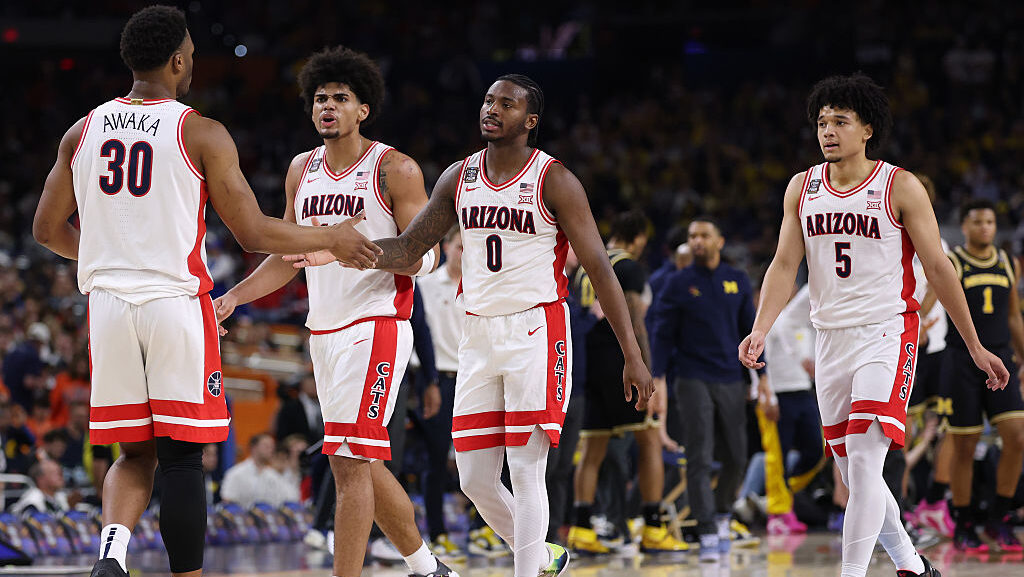
INDIANAPOLIS, INDIANA - APRIL 04: Tobe Awaka #30, Koa Peat #10m, Jaden Bradley #0 and Brayden Burries #5 of the Arizona Wildcats react against the Michigan Wolverines in the Final Four of the 2026 NCAA Men's Basketball Tournament at Lucas Oil Stadium on April 04, 2026 in Indianapolis, Indiana. (Photo by Michael Reaves/Getty Images)
(Photo by Michael Reaves/Getty Images)
A full college basketball season and an NBA Combine process are done with. The 2026 draft class officially reduced by 38 early entry candidates on Thursday, with Arizona Wildcats forward Koa Peat keeping his name in the pool of players going pro for 2026-27.
He will be joined in the draft by Arizona teammates Brayden Burries, Jaden Bradley and Tobe Awaka, while Ivan Kharchenkov and Motiejus Krivas opted to return to Tucson.
There are more individual workouts on the table, but it’s at a point in time where we can look at the swings in where the Wildcats’ talented 2025-26 roster began and have some confidence in where the remaining draft candidates will be selected.
That’s easier to project for first-round candidates but less so for second-rounders. The second day of the draft often becomes a choose-your-favorite-flavor for teams, while agents are willing to push their clients to the right fit or out of the draft altogether to get guaranteed contracts on teams with more promising opportunities.
What does that mean for Arizona’s prospects?
We’re comparing ESPN draft analyst Jeremy Woo’s big board from mid-November 2025 to his latest after the 38 prospects opted out of this draft and considering other expert mock drafts and big boards from early or before the college season to see how far stocks have changed.
G Brayden Burries
Then: 41st
Now: 11th
Burries was by far the biggest winner of the season, entering the year as a likely second-round choice. Now, he’s widely regarded to be picked in the 8-12 range of the lottery. What changed?
While he’s older for a freshman, Burries showed more than anticipated as a three-level scorer, knocking down 39% of his threes at an intentional volume (4.6 per game) and shooting 49% overall. It was his on-ball presence that further built his stock, as his cleverness, balance and array of moves make up for a lack of pure downhill pop.
More than that, Burries averaged 2.4 assists to 1.5 turnovers to go with his 16.1 points per game, eventually becoming relied upon as a backup point guard when Jaden Bradley was on the bench.
Then there was his defense. It was solid enough on the ball, but it was jamming up drivers with his help defense and instincts in passing lanes that helped him to 1.5 steals per game.
All of that is important to profile Burries as a 6-foot-4 combo guard rather than an undersized scoring specialist.
F Koa Peat
Then: 8th
Now: 25th
Peat never lived up to his top-10 projected stock after a 30-burger in his season debut that came against a large Florida frontline. He ended up shooting 35% from 3-point range on very few attempts before the combine and workouts in the past weeks put doubt on his jumper.
There are signs of a mid-range jumper being successful in Year 1, but it’s to be determined if that would be deemed usable in the modern NBA unless he’s in the right offense, surrounded by the right teammates.
At Arizona, Peat lived around the rim, bullying smaller college players with his size rather than elite athleticism. His defense was strong from a team standpoint, but he did little to show anything elite on the glass or on defense that would draw comparisons to Draymond Green as a switchable 4 or undersized center.
What might draw such comparisons is the 2.6 assists and ball-moving abilities that are well-received in the NBA — but the value of that is blemished if a power forward can’t draw defenders out to the 3-point line.
PG Jaden Bradley
Then: 100th
Now: 39th
Clutch shooting throughout the season put Bradley in the spotlight as the Wildcats’ leader and go-to guy. Big 12 coaches named him the conference player of the year based on that, as well as his manning of the controls and defensive reputation.
ESPN’s Fran Fraschilla even likened him to former Villanova point guard Collin Gillespie, who entered the league without much buzz before he broke out for the Phoenix Suns the past two seasons.
But Gillespie has a trigger — and an accurate deep shot — much unlike Bradley’s mid-range heavy game. The Wildcat product will have to recalibrate and increase his aggressiveness from the perimeter as a spot-up shooter, because the athleticism, handles and speed to get to the bucket won’t be there in the NBA like it was at Arizona.
Bradley weighed in at 205 pounds with a 6-foot-6 wingspan at 6-foot-3 at the combine, but like it is on offense, he will have to prove more physical and less of a movable pest on defense.
C Tobe Awaka
Then: Unranked in top 100
Now: 49th
Of Arizona’s players, Awaka has the best NBA-ready trait. He rebounded 20.2% of his own teammates’ misses, which led all of college basketball, and was second on the defensive side.
The possession generating in spot minutes will be highly valued, as will his physicality and decent switchability.
He averaged 9.3 points and 9.1 rebounds in just 20.3 minutes per game.
Awaka surely will impress NBA teams in interview settings, and his selflessness already stands out for pushing head coach Tommy Lloyd to start Krivas and Peat ahead of him before this season.
Related
 ‘It was a disaster’: Sean Miller reflects on his viral sweaty shirt moment from 2016
 Ex-Arizona basketball player Kerr Kriisa pleaded guilty to wire fraud
 4-star center Kamsi Awaka, brother of former Wildcat Tobe, commits to Florida over Arizona
 Arizona misses on 5-star Phoenix recruit Darius Wabbington as he commits to Indiana
 University of Arizona requests to extend AD Desireé Reed-Francois
 ‘I love where Bryce is at’: Tommy Lloyd speaks highly of James’ development

Comments
0 Comments