
Arizona’s blueprint to dominance and potential kryptonite in the NCAA Tournament
The Arizona Wildcats will get a No. 1 seed on Selection Sunday for the NCAA Tournament, and with it comes the 30-2 squad facing the most pressure to make a Final Four in at least a decade.

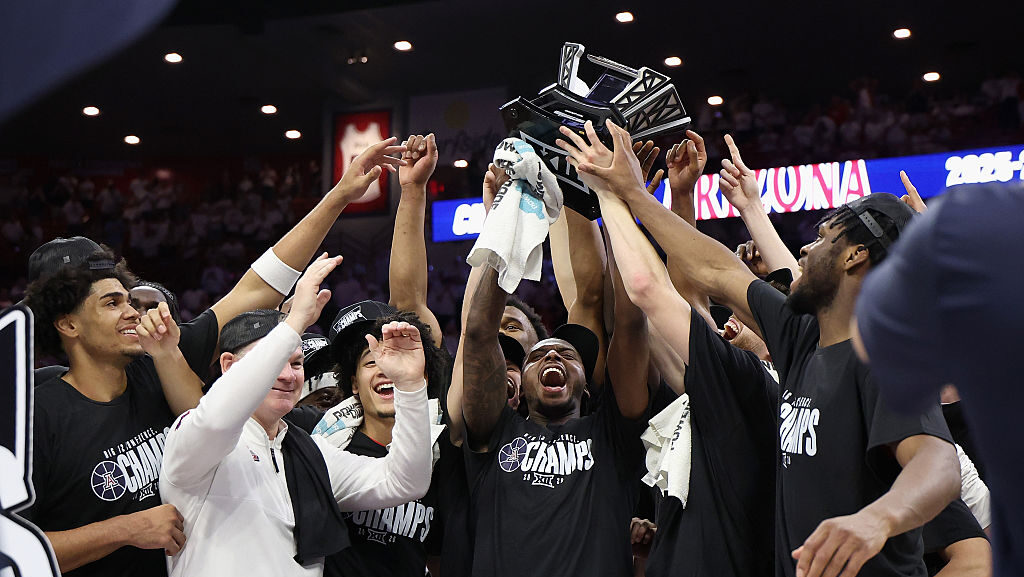
(L-R) Koa Peat #10, head coach Tommy Lloyd, Brayden Burries #5, Jaden Bradley #0 Anthony Dell'orso #3 and Dwayne Aristode #2 of the Arizona Wildcats celebrate winning the Big 12 regular-season title following the NCAAB game Iowa State Cyclones at McKale Center at ALKEME Arena on March 02, 2026 in Tucson, Arizona. The Wildcats defeated the Hawkeyes 73-57. (Photo by Christian Petersen/Getty Images)
(Photo by Christian Petersen/Getty Images)
The Arizona Wildcats will get a No. 1 seed on Selection Sunday for the NCAA Tournament. With it comes the 30-2 squad facing the most pressure the program has come under in at least a decade to make a Final Four, an elusive accomplishment the school hasn’t succeeded in snatching in a quarter-century.
Arizona was the class of the Big 12 this season under head coach Tommy Lloyd, routinely outperforming elite programs in the game’s best conference. The Wildcats set a high bar before conference play even began, with statement wins over two schools that account for the last three titles, Florida and UConn.
The dominant nature of a well-rounded group with enormous strengths and few weaknesses has inspired a whole lot of confidence that it will make it past the first two weekends of the tourney.
While that is the odds-on outcome, this is March. Anything can happen in the tournament, especially in recent years, where matchup-dependent draws now seem more important than ever.
We’ll see if last year’s outcome of four No. 1 seeds in the Final Four was a blip, as it defied the previous trend of several teams without a first or second seed making a huge run across the last several tournaments.
So, what could get in Arizona’s way of what it has crafted into what feels like its destiny at this point? And who could stop it?
Friday, we will cover a group of teams that Wildcat fans should hope don’t end up in Arizona’s bracket. After Selection Sunday, we’ll assess their bracket for those landmine teams and see where Arizona could be tripped up. But first, a look at who Arizona is as a team, and the kryptonite that could put a halt to the momentum of a magical season.
How Arizona dominated most of college basketball
Arizona’s blueprint has remained consistent.
It physically overwhelms opponents, primarily inside through arguably the best frontcourt trio in the country, comprised of junior Motiejus Krivas, freshman Koa Peat and senior Tobe Awaka. All three bring some NBA-level combination of size, length, strength and quickness.
Krivas has improved as a post presence and a defensive anchor at 7-foot-2, Peat brings good agility as a strong and switchable defender with a refined mid-post game, and there is no better rebounder in college basketball than Awaka, who also has speedy pressure in ball-screen defense on the perimeter as a blitzer/hedger.
Peat appeared to be the only real threat as an individual scorer coming into the season, but Krivas and even Awaka have had terrific offensive performances.
Arizona is supremely confident feeding the ball to all three with their back to the basket and will rely on any of ’em in crucial moments.
The perimeter defense, led by Ivan Kharchenkov, is where Arizona’s athleticism shines further. The freshman from Germany has quickly become elite in that category, joining senior point guard and Big 12 Player of the Year Jaden Bradley as a pair of top-notch aces in making ball-handlers uncomfortable.
Reserve freshman Dwayne Aristode has the best tools of the bunch, and don’t sleep on freshman guard Brayden Burries as a defender either, as he and Peat both have a chance to be lottery picks in June thanks to their balanced two-way games. Awaka and Peat can switch out there too, giving Lloyd tons of scheme versatility that he has used well this year.
It’s more of the same offensively, where the Wildcats are easily the most balanced team in the nation. Burries is the leading scorer, whose 16.0 points per game incredibly rank 214th in the country and 17th in the Big 12 on a powerhouse of a team. Any of their seven primary players can be the guy.
The Wildcats lean on establishing Krivas and Peat early, something Bradley does a great job of orchestrating, but anyone can be insulated as the top option. Even senior guard Anthony Dell’Orso had some huge outings in conference play off the bench.
When Bradley, Burries and Kharchenkov are in a groove getting downhill, whether that’s to the rim or being shot-makers in the midrange, that’s when the offense is truly unstoppable.
Arizona mauls opponents with 43 rebounds per game (second in NCAA D1), and that plus the constant pressure gets 26.2 free throw attempts per game (11th). That’s where even when the shots aren’t going down, the Krivas/Awaka duo can swing games by being no further than five feet away from the basket.
And it should be emphasized that this team has kept getting better. While the heights were pretty freaking high early in the year, the defense especially has picked it up over the last two months.
There is so much individual growth, too, mainly from Burries and Krivas, who have both improved their draft stocks considerably. Reserves like Aristode and Dell’Orso that can go from 10-to-25 minutes played, depending on the night, have also had confidence-boosting stretches.
It’s a team that checks every box when it comes to the month-to-month trajectory that a college basketball season is often defined by.
Where Arizona is vulnerable
How you beat Arizona is limiting a lot within what we discussed, plus a few more hyper-specific details that certain matchups could capitalize off.
No one can beat the Wildcats unless the opponent accepts that part of the challenge will mean defeating them at their own game. Physicality is a must, not only matching it but having the size to counter it. Any team without at least two trustworthy bigs will have serious issues, and they might need three.
Arizona’s interior superiority can feel like an apocalyptic force when it’s rolling, but when the opposition has kept it from taking over, the Wildcats suddenly devolve from an outstanding team to a vulnerable one.
Points in the paint often tell the tale there. In Arizona’s two losses, to Kansas and Texas Tech, it was only a combined +2 for points in the paint. In its 10 wins over ranked opponents, it was +138, good for an average margin of +13.8.
It’s a gap fueled by the defense. Krivas is a first-round prospect thanks largely to his rim protection. Awaka’s great there too, and then the size and length on the perimeter keeps enough contained, or at least has drivers very uncomfortable.
Rebounding is obviously a big one too. Arizona’s rebounding margin ranks fourth in the country. If the Wildcats, who haven’t been as elite as you’d expect on the offensive glass, get going in regards to grabbing their own misses, then it is game over.
From there, it’s denying easy looks for Arizona’s offense. If double-teams in the post are met with sound rotations off the ball, high-low passing lanes are denied and the guards are kept out of the paint, it turns into a fairly average offensive unit.
Burries is a great shot-maker while Bradley is a comfortable midrange shooter who likes to finish at the rim, but neither are great playmakers. Bradley is the biggest threat with that, but his decision-making is a mixed bag.
Bradley will often times miss a kick-out pass, go on an out-of-control drive right into the help defense or take a contested middie. He’s a notorious slow starter, and that’s incredibly dangerous in the tourney.
Bradley has been a big-time closer in a few huge wins, and that earned him a lot of hype as the senior leader of the team. He’s been nails in a handful of other key victories.
But the volatility within his choices attacking a defense have also cost Arizona, like in the loss to Texas Tech when he missed his last eight shots. The Wildcats as a team are also outside the top-100 in turnovers per game, so the instability from him can have a trickle-down effect.
If most of that is in check, the obvious win condition for upset hopefuls is from 3.
The Wildcats are a moderately efficient 3-point shooting team at 35.3%, 106th in D1, but really suffer with volume and only attempt 16.5 a game, which ranks 357th.
They simply don’t feel the need to rely on it, nor churn ball movement enough to put opposing defenses in rotation to create them. Burries (4.4 3PA/G) and Dell’Orso (3.9 3PA/G) are the only two players who cracked 100 attempts, and Dell’Orso will get played off the floor at times due to his physical profile not matching the team’s identity.
Arizona has staggeringly had 14 games with five or fewer made 3s, with the national average being eight. It has avoided getting bombarded so far, which speaks to how well Arizona can defend the 3-point line, but it’s also a potential omen for that coming soon enough.
The season high against the Wildcats is 13 makes from 3, and only five times has an opponent knocked down at least 10.
When the math adds up, it’s a coin flip finish. In the three games where Arizona made five or fewer triples and 10-plus 3s went down for its opponent, it was really close late, including the Texas Tech loss in overtime. The weakness flared up against marquee opposition, too.
The Wildcats only made two triples against Florida and UConn, three versus Houston and four against Kansas and BYU. Arizona better hope it doesn’t run into the wrong 3-point shooting team on the same night it looks mortal in the paint.
Lastly, star power is worth a shout. Arizona’s done a fantastic job neutralizing some of the best players in the country defensively, but there have been a handful of Wildcat performances offensively where not having a go-to guy leads to a stagnant grind of a night.
Peat and Burries have their freshmen inconsistencies, and we covered how Bradley can, at times, be an enigma. Sometimes, the balance leads to, well, no one standing out. That happening against someone having a March moment is certainly on the table.
Related
 Arizona cruises to Big 12 quarterfinal win over UCF, rematch with Iowa State next
 Big 12 men's basketball tournament schedule: Arizona to face Houston in championship game
 UCF rallies past Cincinnati in OT, will face Arizona in Big 12 Tournament quarterfinals
 Tommy Lloyd wins Big 12 coach of the year, Jaden Bradley highlights Arizona's loaded Big 12 awards
 Arizona basketball picked to win Big 12 in coaches poll, Motiejus Krivas is Preseason Player of the Year
 Sam Vecenie’s first 2027 NBA mock draft sees 3 Wildcats selected in the top 10
Comments
1 Comments
Three "issues" that will get an earlier than expected exit for the Cats . . . And I'm talking an Elite Eight loss, as they're not losing before then. 1-A team gets ridiculously hot from three, just like Wisconsin did against Sean Miller's team. 2-They let a team back into the game; like yesterday against UCF. 3-Missing free throws. They get into a tight game, it's going to be their Achilles' Heel. It's up to Tommy to keep them mentally focused, and either way, it should be a hell of a ride.