
Texas’ Sean Miller once thought about Final Four ‘every 10 minutes,’ now he’s happy for Arizona
Sean Miller reflected on Arizona’s Final Four breakthrough, his past heartbreaks and why focusing on daily growth matters more than the end goal.

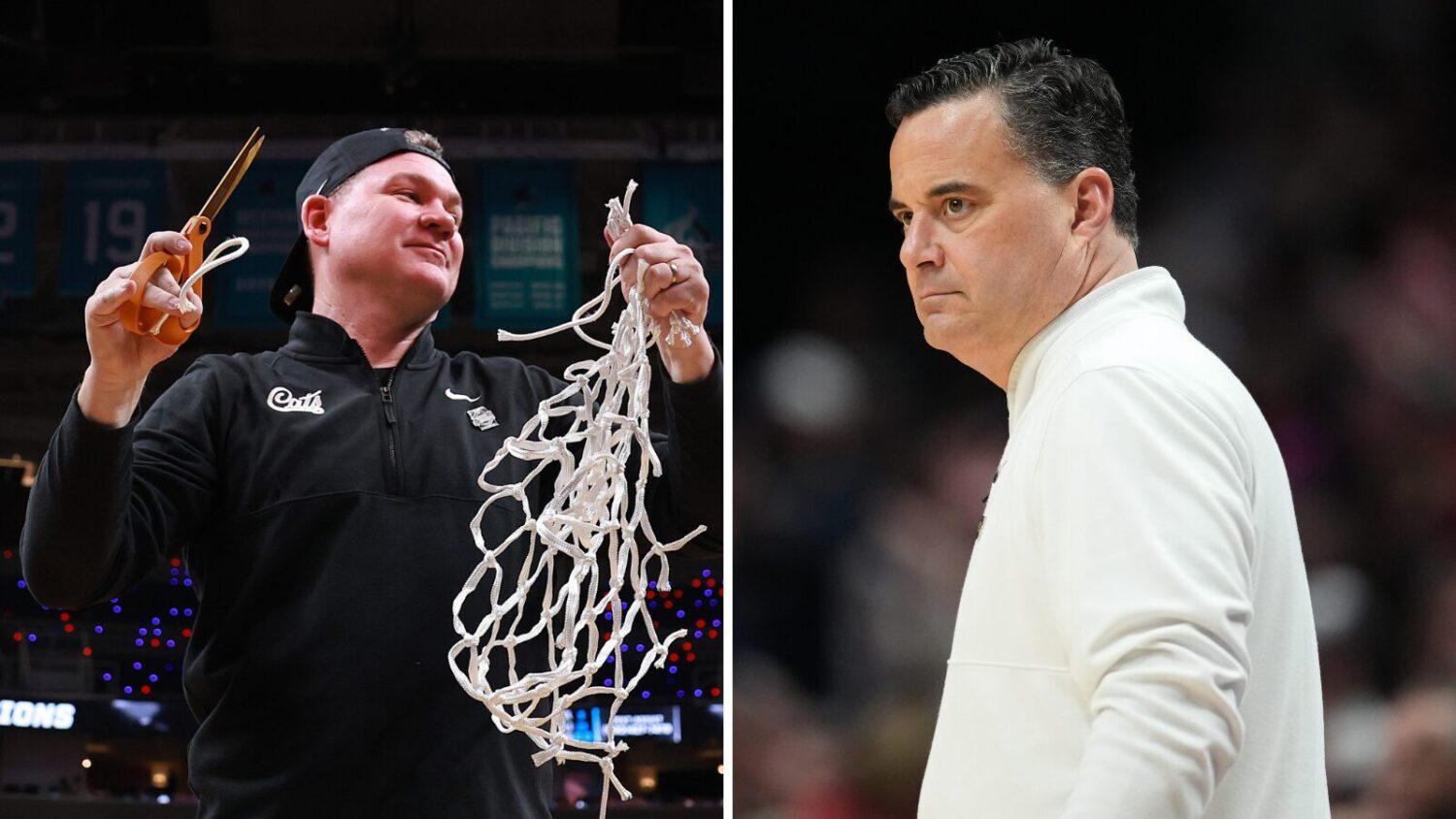
Sean Miller reflected on Arizona’s Final Four breakthrough, his past heartbreaks and why focusing on daily growth matters more than the end goal. (Getty Images)
(Getty Images)
Before Tommy Lloyd guided Arizona back to the Final Four last spring, the program endured a quarter-century of March heartbreak.
Between Arizona’s 2001 national championship game appearance and last year’s breakout run, the Wildcats reached 12 Sweet 16s and five Elite Eights without cutting down the nets in the regional finals.
Seven of those NCAA Tournament appearances and three of those Elite Eight trips came during Sean Miller’s 12-year tenure in Tucson (2009-21), a stretch defined by five Pac-12 regular-season titles, elite talent and crushing misfortune.
From LaQuinton Ross’ game-winning 3-pointer for Ohio State in 2013 to Brandon Ashley’s season-ending foot injury for the then 21-0 No. 1 Wildcats in 2014 and Stanley Johnson’s unfortunate eye injury against Wisconsin in 2015, Miller’s best teams repeatedly fell just short of the sport’s biggest stage.
Yet, as he watched his former program break through, Miller harbored no resentment.
“I have no bitterness. I lived there for 13 years,” the now Texas head coach told Jon Rothstein on CBS Sports‘ Inside College Basketball Now. “The job that Tommy Lloyd has done at Arizona is nothing short of incredible. And just to watch their team from start to finish, they deserved to be there. It was great to see them get there.”
What was it like for Sean Miller to watch Arizona make the Final Four?https://t.co/37P3IN8oeo (Apple) https://t.co/sNq3sf2nZc (Spotify)https://t.co/fjt9vg2n3A (YouTube) pic.twitter.com/EEElCZOWtg
— Jon Rothstein (@JonRothstein) August 25, 2026
Miller’s time in Tucson ended in April 2021 when the university fired him following an NCAA investigation that charged the school with five Level I violations. Despite the exit, his personal connection to the program remains strong.
“Do I wish a couple of the times where we were a play away in the Elite Eight that we would’ve got there? Yes, but that doesn’t take away at all from me hoping that they do well,” Miller said. “I’ve coached too many players, had so many great moments, friendships, relationships, which includes my three sons who graduated from there to feel anything other than joy for their success, and I mean that in a heartfelt way.”
That perspective marks a shift for Miller. In 2013 while still at Arizona, he famously admitted to Rothstein that he thought about reaching the Final Four “every 10 minutes.”
Looking back, Miller views that mindset as a trap.
“My response wasn’t a good one,” Miller said. “It was honest, but it really wasn’t a good one because it’s really what inevitably can do you in. Again, you’re fixated on the results — something that is a byproduct of your every day.”
Miller realized that obsessing over the destination distracted from the daily process required to get there.
“When you start to reflect on the end and you can’t do both — you’re now not paying attention to the details of what you do every day,” Miller said. “I try to focus more on what is it that we’re doing, and how can we be better at it. I think that’s a much healthier approach towards getting to the end result.”
Following Arizona’s Elite Eight victory over Purdue, Lloyd deflected praise, pointing instead to the foundation laid by program legends like Lute Olson and Miller.
The gesture wasn’t lost on Miller, who noted that a program’s true identity stems from its players and the culture built over generations.
“Well, I appreciate him even thinking that way or saying that way,” Miller said. “You learn over time the great players, they define a program. … If you create an environment for really talented young people and they achieve and they reach goals, that’s really what this is about.”
Miller recalled how former Olson players like Jason Terry, Damon Stoudamire and Joseph Blair served on his own coaching staff in Tucson, bridging generations of Wildcats basketball.
“It’s so much about how much you care about them, how you treat them, what they accomplish and how they feel when they think about the program,” Miller said. “I think that’s what makes all of us as coaches keep coming back.”
Related
 University of Arizona requests to extend AD Desireé Reed-Francois
 ‘I love where Bryce is at’: Tommy Lloyd speaks highly of James’ development
 Big 12 reveals ASU, Arizona basketball’s 2026 conference schedule
 Arizona’s RJ Godfrey remains in waiting game as NCAA eligibility hangs in the air
 Arizona PF RJ Godfrey not considered eligible after NCAA granted stay
 Big 12 becomes latest conference to ban former NFL players while NFL reiterates its rules

Comments
2 Comments
Although things didn't end well for Miller, he did some good things in Tucson . . . Two bad breaks, and Wisconsin shooting three's at an unreal clip buried his Final Four chances. He'll do well at Texas.
Nothing he did that isn't legit now. He had to pay the price but rep'ed the CATS well. He might get a chip at TX, he can recruit his ass off.