
Louisiana judge rules against NCAA, clearing path for ex-NFL players to join LSU roster
The ruling clears the way for LSU to list some former NFL players on its roster, including former Saints defensive lineman Zxavian Harris and former Browns tight end Dae’Quan Wright.

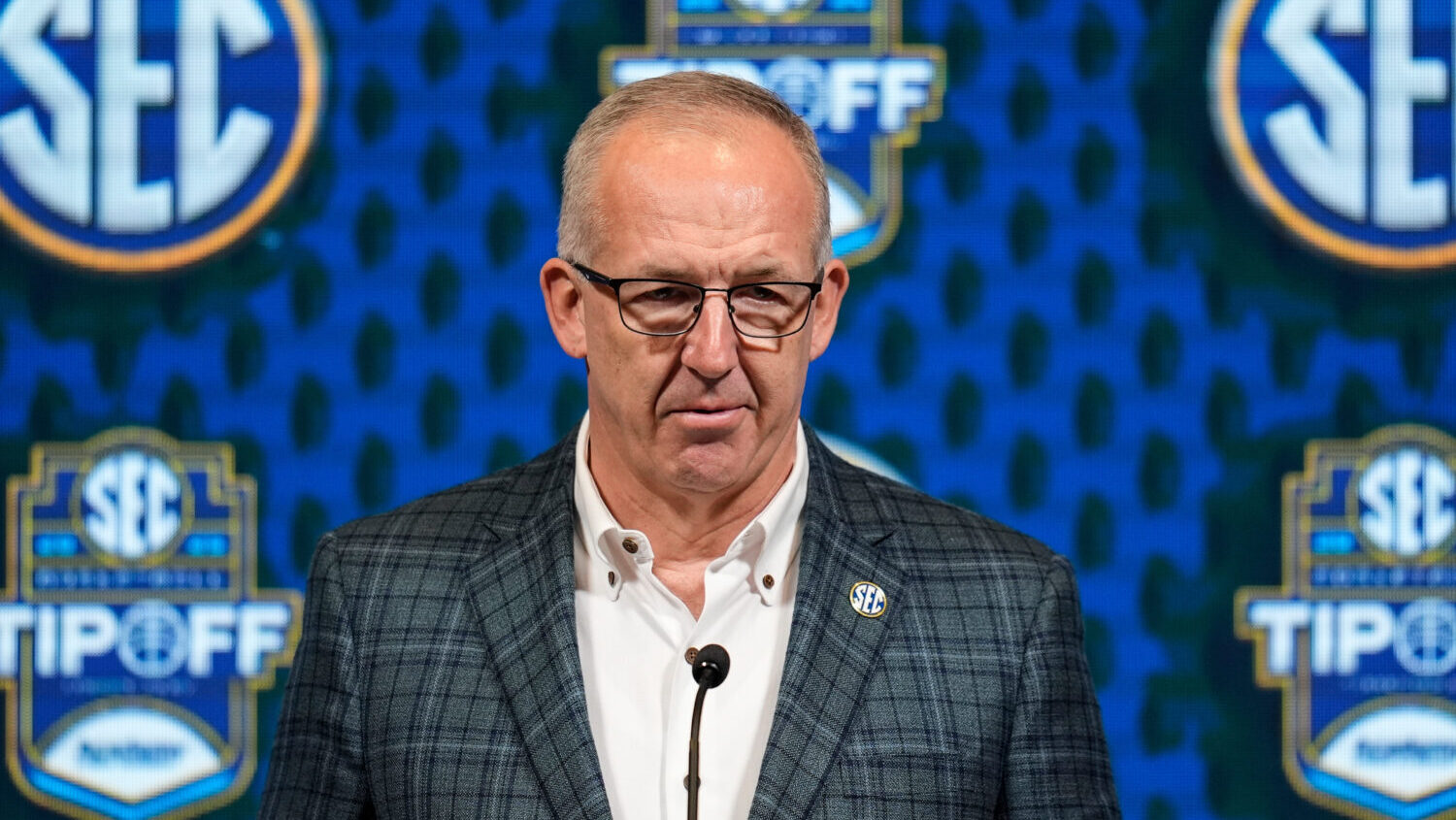
FILE - Greg Sankey, commissioner of the Southeastern Conference, speaks during NCAA college basketball women's SEC Media Day, Oct. 16, 2024, in Birmingham, Ala. (AP Photo/Mike Stewart, File)
(AP Photo/Mike Stewart, File)
LSU coach Lane Kiffin’s chances of fielding former NFL players improved Thursday night when a Louisiana judge issued a preliminary injunction against the NCAA in a high-profile eligibility case.
East Baton Rouge Parish Judge William Jorden issued his ruling the night before LSU was due to submit its 105-man roster to the Southeastern Conference, which last week announced heavy potential punishment for football and basketball teams that bring in ex-pros.
The ruling clears the way for LSU to list some former NFL players on its roster. How many games they might be eligible to play remains to be seen as the matter continues working its way through the courts.
Jorden said he considered sanctions against the SEC and the NCAA but ruled he was not ready to issue any at this time.
Jorden’s decision followed a nearly nine-hour hearing in a courtroom near the LSU campus in which athlete after athlete took the stand to explain why they should be allowed to return to play college sports after turning pro. The commissioner of the powerful SEC argued against them, and the league doubled down by filing a lawsuit against the school in federal court. That lawsuit could now become the SEC’s best chance at preventing former pros from playing this season.
The courtroom confrontation came just two days before 11th-ranked LSU opens the season at home against Clemson. Jorden scheduled the hearing over his temporary injunction preventing the NCAA from barring former pros or fifth-year college athletes, a stance reiterated by the SEC and other Power Four conferences in potential punishments adopted last week.
Former NFL players testify about modest pay in pros
Former New Orleans Saints defensive lineman Zxavian Harris and former Cleveland Browns tight end Dae’Quan Wright, two players who hope to suit up for LSU, sat next to each other in the gallery as the hearing began and both took the stand to say they would not have tried to turn pro had they known they might get another year in college.
Harris and Wright said they each earned about $1 million in college. Harris said he was paid just $190 in travel expenses by the Saints and spent all of his time with the club rehabbing a foot injury. Wright said he was paid a $25,000 signing bonus by Philadelphia before his brief time with the Browns and would gladly pay that back for the chance to play for LSU.
Two LSU soccer players, Jazmin Ferguson and Jocelyn Ollivierre, won earlier court orders and have already played this season. Ferguson testified that she was paid $4,500 by a USL team, but ended her contract and paid the money back in hopes of clearing the way to play for the Tigers again. Two LSU softball players also testified.
The athletes testified after SEC Commissioner Greg Sankey was on the stand for more than two hours, defending the league’s authority to enforce its week-old rules barring former pros from returning to play at its 16 member schools. He said school presidents and chancellors felt that they needed to establish a line between professional and college sports and that there needed to be ways to hold schools accountable.
“The line between professional sports and college sports needs to be maintained,” Sankey testified, adding that the league was concerned about incoming athletes being displaced from limited roster spots.
As he spoke, the SEC filed the federal lawsuit in Alabama against LSU and its leadership, alleging the school had “waged a deliberate and coordinated campaign to recruit professional athletes” in defiance of league rules. The court filing against one of the league’s founding members in 1933 seeks an injunction barring LSU from violating the SEC’s First Amendment rights by forcing it to “associate with conduct that is contrary to the conference’s purpose and mission.”
Legal experts said the filing was a backup in case the SEC lost in state court. Outside the courthouse in Baton Rouge, plaintiffs’ attorney Tony Clayton said: “I got a problem with that. I mean, you go around, you can file this suit in any state. You’re suing LSU. Sue them in Louisiana. You go to our nemesis: Alabama. Really? So, so that lets you know what the commissioner is all about.”
Questioning of Sankey turns sharp
In questioning Sankey, attorneys for the athletes cited numerous examples of when SEC eligibility rules align with NCAA rules, suggesting the potential of collusion. They questioned why league members met last week to adopt stiff penalties for the very actions addressed in the Louisiana state court’s temporary injunction against the NCAA.
The attorneys also asked why the SEC singled out players who signed contracts with specific U.S.-based leagues — the NFL, NBA and WNBA — but not overseas pro leagues or women’s pro soccer leagues. When Sankey tried to qualify an answer about whether the SEC had previously punished a school for adding a player with previous pro experience, Clayton said, “I didn’t ask how to build a clock. I’m just asking what time it is.”
Sankey acknowledged that there had previously been no such punishment, but that it had been considered against Alabama last basketball season when the Crimson Tide briefly added a former G League player.
Players going to court has become common
The players in question also include former Denver Broncos defensive back Blake Cotton, who like Harris and Wright is hoping to join LSU and Kiffin.
Wright, who played for Kiffin last season at Mississippi, started practicing at LSU this week, too late to be eligible for Saturday’s home opener against Clemson under the NCAA’s required seven days of practice. Harris, who also played at Ole Miss last season, has committed to LSU, while Cotton, who played at Utah last fall, has been recruited by Kiffin.
All three are among a host of athletes who’ve argued in lawsuits around the country that they are unfairly being denied an opportunity to spend a fifth year in college under newly adopted NCAA rules allowing for five full years of competition. In all, the NCAA says there are approximately 450 athlete plaintiffs seeking additional eligibility through litigation, with some 300 of them winning the ability to play at least for now.
The athletes in the case who signed pro contracts have argued they did so only because current rules that would have allowed them another college season weren’t adopted until after their decisions to leave for the chance to make an NFL roster.
The SEC contends the question before the judge should be a narrow one regarding whether the conference “can enforce and require its member institutions to comply with SEC rules.” The SEC’s proposed punishments include significant fines, up to half-season suspensions for coaches and member universities’ loss of voting privileges on league business matters.
Sankey provided an affidavit stating that SEC university presidents had voted 15-0 in favor of the new rules, with LSU’s Wade Rousse abstaining.
The fight over eligibility between schools and their own conferences and the NCAA has simmered for months and spilled into politics.
Louisiana Attorney General Liz Murrill chatted with plaintiffs’ attorneys before the hearing and filed a brief on their behalf. Louisiana Gov. Jeff Landry posted on X to attorneys general in Georgia and South Carolina that “calling them ‘NFL players’ is at best disingenuous, and at worst intentionally deceptive … They are not professional football players circling back after years in the NFL. They are college players who were told, by the NCAA, that they were done. So they took the only door that was open — only to watch the NCAA change the lock behind them.”
Related
 Arizona’s Tommy Lloyd expresses frustration at RJ Godfrey’s eligibility issues
 Steve Nash visits ASU football to ‘break up the monotony’ of Kenny Dillingham’s voice
 Report: ASU expected to start Mikey Keene at quarterback vs. Kansas State
 Should ASU start freshman Jake Fette at quarterback?
 Greg Powers receiving more than $1.3M in separation agreement with ASU
 Report: Moe Odum enters transfer portal, not allowed to return to ASU due to Big 12 rules

Comments
5 Comments
This is anything but over. The SEC lawsuit against LSU will likely be heard tomorrow in Alabama where it's expected that the Court is going to rule in favor of the SEC saying that Conferences have the right to oversea their member institutions.
Once that happens, the matter is ripe to have all the various Inferior Court rulings, including todays, consolidated in a Superior Court, which might have to go pretty far up. Fact is players have been Judge shopping in lower inferior Courts ruling on a common issue in any number of jurisdictions. In numerous of those cases Courts have ruled despite their being massive Conflicts of Interest, which will make the case ripe enough to gain the attention of SCOTUS. The one Superior Court, an Appeals Court in Dallas, previously ruled, went in favor of both the players, the NCAA and the Conferences.
I expect that tomorrow override all previous rulings and force the consolidation to SCOTUS to resolve the matter. I also believe the in Committee the SEC will rule to issue really harsh sanctions against Kiffin and LSU if they're stupid enough to officially put the involved players on the official LSU roster, and near draconian sanctions against those 2 if they are allowed to dress and/ or take the field.
I believe it speaks volumes that the Court that ruled today issuing the injunction, did not sanction the losers. I suspect that SCOTUS will grant certiorari, and leave the Court of Appeals decision in place, quashing all the previous injunctions in favor of the players, preventing any professional players from returning to college, which upholding the 5th year eligibility ruling for the 2022, but restricting their ability to transfer.
The SEC just told LSU they're not playing around today, when they asked the Court for authority to expel LSU from the Conference, while at the same time scheduling a vote for Thursday.. Lane Kiffin mouth has cut checks that the rest of him won't be able to cash. Love seeing the SEC go after this clown and LSU.
As predicted previously, Lane Kiffin and the SEC blinked and didn't put the 2 Pro Players on the Roster. LSU and Kiffin understand that they're going to lose on appeal, and they don't want to face the wrath of the SEC when the Courts rule that Conferences have near absolute authority to regulate the conduct of their members, which is a reasonable standard. That wrath would include, at a minimum, Kiffin being suspended for at least half the season, with LSU football program getting their budge cut in half, possibly over several year. I wouldn't be surprised if the sanctions the SEC issues are very severe, borderline draconian. Thing is, both Lane Kiffin and LSU are highly likely to get smacked around by the SEC for their stunt, as they want to send a strong message. There is a lot of talk that if the SEC voted today, they would unanimously act to kick LSU out of the SEC, which speaks volumes since LSU is one of the founding members.
Again, the fact is ALL the Conferences are in total unison on this one: They don't want professional athletes in college football and it's a hill they're willing to die on.
It's disingenuous that Arizona Sports didn't cover this story, but understandable, since the one posted is just so completely wrong.