
Suns’ Earl Watson wants Dragan Bender to play a little point guard
If we're judging by Twitter majority, Suns fans wanted Dragan Bender to play less at small forward in 2016-17 and more at power forward or even center.

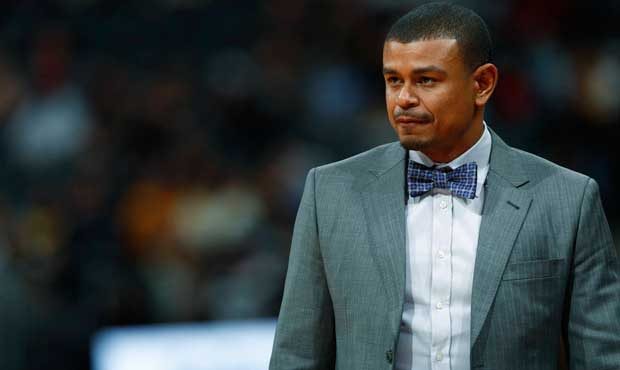
Phoenix Suns head coach Earl Watson looks on against the Denver Nuggets in the second half of an NBA basketball game Thursday, Jan. 26, 2017, in Denver. The Nuggets won 127-120. (AP Photo/David Zalubowski)
(AP Photo/David Zalubowski)
If we’re judging by Twitter majority, Suns fans wanted Dragan Bender to play less at small forward in 2016-17 and more at power forward or even center.
Such a request wasn’t as easy to manage for coach Earl Watson with Marquese Chriss and Jared Dudley at power forward and Tyson Chandler, Alan Williams and Alex Len playing center. Adding to the questions, Bender got hurt just before the All-Star break as Phoenix began resting its veterans and didn’t return until the final five games of the year.
Waiting to see Bender’s defensive position will have to wait until the roster shapes out through free agency, but Watson already dropped a hint about the offensive role the Suns will try to carve out for him in Summer League.
Queue the “positionless basketball” conversation.
“We want him to take the ball off the rim as a rebound and push it. We want to see him make plays. We want to figure out a system where he can run some point, just let him open up his game,” Watson told Doug and Wolf on 98.7 FM, Arizona’s Sports Station on Wednesday.
Bender, 19, averaged 3.4 points and 2.4 rebounds in 43 games as a rookie last season.
DRAFTING BECOMES MORE LIKE RECRUITING
More and more, NBA draftees have dictated which team selects them by controlling their own workouts.
In 2016, Kris Dunn’s refusal to work out for several teams — those like the Suns who had too many point guards already on the roster — likely led him to the Minnesota Timberwolves.
This past draft, the Suns’ No. 4 overall pick, Josh Jackson, rubbed Celtics president of basketball ops Danny Ainge the wrong way when he canceled a workout as Boston brass was headed to see him work out in Sacramento.
That Jackson even had a workout in Sacramento, where the Suns eventually met with him, said a lot about how the pre-draft process has changed.
Top prospects are bringing NBA front offices to their own workouts rather than the other way around.
“You’re starting to see now these young guys coming into the draft, you must have a relationship or built a relationship very quickly with their support group. They’re not coming to Chicago (for the combine) anymore,” Watson said. “If you do not (have a relationship), it’s very difficult to actually get a workout.
“It’s starting to become a different game in the NBA, which to me we’re dealing with younger players. It sounds exactly like, to me, NBA staffs, they must start recruiting like college.”
Watson, who runs an AAU program in the Los Angeles area, should know.
He came into the NBA as a coach prepared with a recruiting book that looked more like UCLA’s than a professional team when he nearly helped Phoenix land then-free agent LaMarcus Aldridge.
Watson sees the draft the same way. While he didn’t say whether Jackson favored Phoenix over Boston because of a better relationship with the Suns, Watson added that he’d already built a relationship with the Kansas product before his freshman year of college.
“I met Josh and his mom probably like five years ago. I met them at an AAU tournament,” he said.
The GM-coach relationship
Watson didn’t hide his feelings that shutting down top veterans like Eric Bledsoe a season ago wasn’t his idea.
That said, he understands working with general manager Ryan McDonough and the front office comes with its disagreements. And Watson knows that everyone within the organization has the same goal.
“No one is saying ‘Let’s lose.’ Everyone wants to win so it’s not gonna always go your way and this is when you have to realize, people are not robotic — so you have to at least give someone some space to have some emotion,” the head coach said. “After that emotion passes we all have to find a positive out of whatever the situation is.
“We found that positive last year with Tyler Ulis having an amazing ending, Marquese Chriss getting better, and how about Derrick Jones coming from nowhere. Alan Williams, who changed his life out of a decision that really didn’t impact him, he took advantage of the opportunity.”
Related
 Mike D’Antoni thinks Shawn Marion should be the next Sun inducted into the Hall of Fame
 Phoenix Suns sign C Duop Reath for depth after Mark Williams injury
 Jimmer Fredette unretires from basketball, will play this weekend in 3×3 tournament in Phoenix
 Suns announce broadcast voices for 2026-27, Rex Chapman gets expanded role
 Former coach: Sarver’s Suns never had serious conversation about drafting Doncic over Ayton
 Is Khaman Maluach ready to step up for Suns in Mark Williams’ absence?

Comments
36 Comments
I'm sold!
Earl Watson does not understand basketball beyond his narrow understanding as a player. While that might give him insight non-players do not have, it does not make him a basketball mind. I have coached many very good players who played like they had BBIQ on the court, but really did not have an understanding of the game in order to be able to coach. They played on instinct and their instincts were just good ones.
Earl is a relationship guy. He would be a great assistant. He is the guy on staff that the players really love, always has motivating speeches, and gets a lot of buy-in to whatever you are trying to do. But he isn't someone who understands what to do.
Case in point, while it seems logical to have a point of attack off a rebound, it actually is not a fundamentally sound practice. Taking a rebound off the glass and pushing the ball is not the best way to advance the ball. It does not speed the game up. Passes are faster than dribbles. Ball movement by kicking the ball ahead to a ball-handler does a number of things that are eliminated when the rebounder takes the initiative. First, it clears the ball of traffic around the rebounder. Next, it advances the ball past the scrum of players still rebounding, putting those defenders behind the ball and scrambling to get down the floor. It also creates a shift of focus, because often you pass to someone ahead that is at a different angle forcing the defenders to switch which way they are facing, thus slowing them down ever further. The idea here is then to advance the ball again by pass to a player further down the floor. If you can get the ball past the defense, it forces the defense to "suck down" to the baseline, then have to recover with closeouts. This is how you get trailers shots, or how they fake and drive, putting the defense in scramble mode.
Dribbling up with your rebounder allows all of the defenders time to find their man while that guy is dribbling through traffic. It places you at risk for turnovers with guys coming from behind, if there are any. Most of the defenders will be "ahead" of the ball, and never forced to "suck down" to the ball on the baseline, so you no longer have trailer opportunities, no kickouts and no closeouts where you can get into the lane. Really all it becomes is an opportunity for one player to isolate and attack the rim, and that generally doesn't work.
Even if Jackson, Bender and Chriss were ballhandlers of the Durant ilk, I would tell them to get it ahead to Bledsoe or Ulis, and then sprint down the court and get yourself ready to be on the receiving end of a pass to score. Whoever rebounds is the trailer, the other big sprints immediately to get low position. Get the ball there quick, then you have a pass out opportunity, or you have one-on-one down low with no help.
Watson is in over his depth on this.
Building a team with teenagers is what you do when don't want to win championships.
So Dragan is going to be a point guard in Suns world.
Yeah, the Suns are in good hands. No dysfunction at all.