
MLB to test ABS challenge system in spring training
Major League Baseball will test out its Automated Ball-Strike (ABS) challenge system at ballparks during spring training, the league announced.

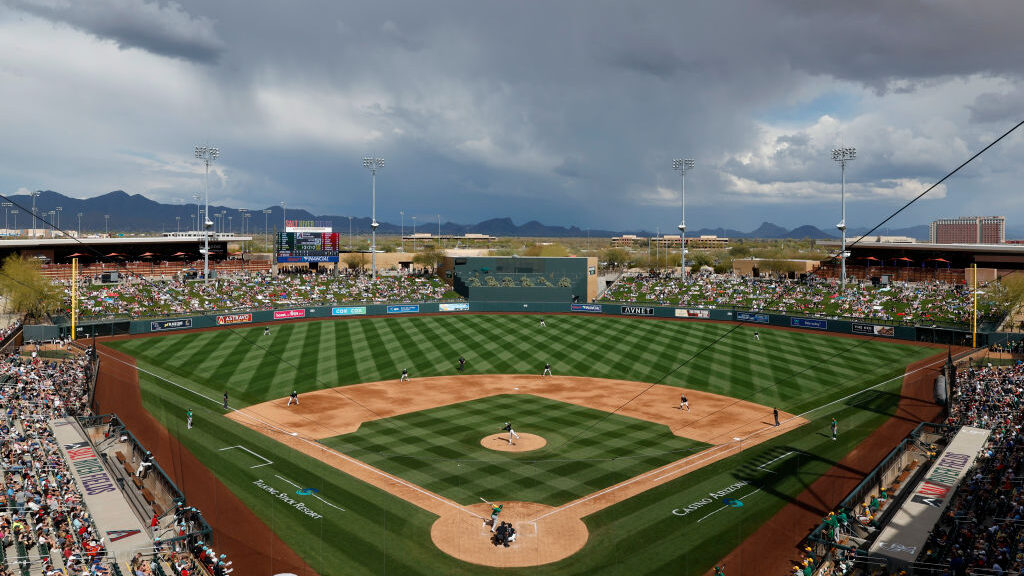
A general overview during a spring training game between the Arizona Diamondbacks and the Oakland Athletics at Salt River Fields at Talking Stick on March 18, 2024 in Scottsdale, Arizona. (Photo by Chris Coduto/Getty Images)
(Photo by Chris Coduto/Getty Images)
Major League Baseball will test out its Automated Ball-Strike (ABS) challenge system at various ballparks during spring training this year, the league announced earlier this offseason.
Diamondbacks fans will watch more games with players challenging balls and strikes than any other fanbase, as The Athletic’s Evan Drellich reported on Friday that a league-leading 29 of Arizona’s spring training games will feature ABS.
The challenge system uses Hawk-Eye cameras to track each pitch. Umpires still make all the calls, but teams will get two challenges for balls and strikes this spring training, according to Drellich. Clubs keep their challenge if successful. Half of the 10 Cactus League parks will feature ABS.
Fans at Salt River Fields who attended the Spring Breakout prospect showcase last year had the chance to see ABS work in action, with players tapping their heads to challenge and the pitch location quickly showing up on the scoreboard in left field.
Here’s what it looked like in a critical spot during a Triple-A game last year:
Upon further review… @GoStripers win it!@Braves prospect Hayden Harris records all of his outs via strikeout to earn the save — with the final one coming on an ABS challenge: pic.twitter.com/dlnBOvUoOs
— Minor League Baseball (@MiLB) September 18, 2024
The D-backs have 37 games scheduled before Opening Day, including their annual two-game exhibition series against the Cleveland Guardians at Chase Field, so a hefty portion of their games will be used to test the system.
MLB started testing ABS full-time in Triple-A in the second half of last season, but the experiment dates back to minor league games in 2022. Many major league veterans, unless they went through a rehab assignment in minor league games, will have the chance to try it out for the first time. Many younger players and prospects have at least some familiarity with it.
The league has made various rule changes in the past couple seasons such as the pitch clock, shift restrictions and pick-off limits.
Testing out the challenge system in major league spring training is the biggest test yet for its potential future implementation in games that count. Perhaps the social media strike zone screenshot will soon go extinct.
Pitchers and catchers report to Diamondbacks spring training on Feb. 12, and Arizona’s Cactus League opener is on Feb. 21 against the Colorado Rockies.
MLB announces couple new rule changes
MLB this week also announced a pair of minor rule changes, one of which tweaks the shift ban.
Players can no longer load up on one side of the infield, and the competition committee this week passed an alteration that further punishes a team for breaking this rule.
Last year, if a team had three players on one side of second base before the pitch, the opposing team had the option of accepting the play as it stood or taking a ball. Now, the hitting team will have a choice of accepting the play or receiving a free base, which would be ruled an error on the defense.
The second change involves running past a bag other than first base. With runners on first and third, a runner digging in for second on a ground ball may run through the base to maintain speed and ensure the run scores.
Previously, if a runner was called out and upon review beat the throw to second, he would be awarded second base due to the missed call. The new rule allows umpires to call the runner out for abandoning the base.
Related
 Former D-backs closer Paul Sewald signs with Guardians
 Spring training dates announced for Diamondbacks pitchers and catchers, full squad workouts
 Wild Card standings: D-backs jockeying for position with Padres
 D-backs’ devastating loss to Marlins squanders chance to tighten playoff race
 Nolan Arenado leaves D-backs game due to thumb injury
 2001 Diamondbacks champions to reunite at Chase Field on Saturday

Comments
0 Comments