
Numbers suggest the Suns hit on Khaman Maluach’s elite skill
Khaman Maluach's rim-protection metrics progressed during his rookie season. There's enough to suggest he could make a leap in 2026-27.

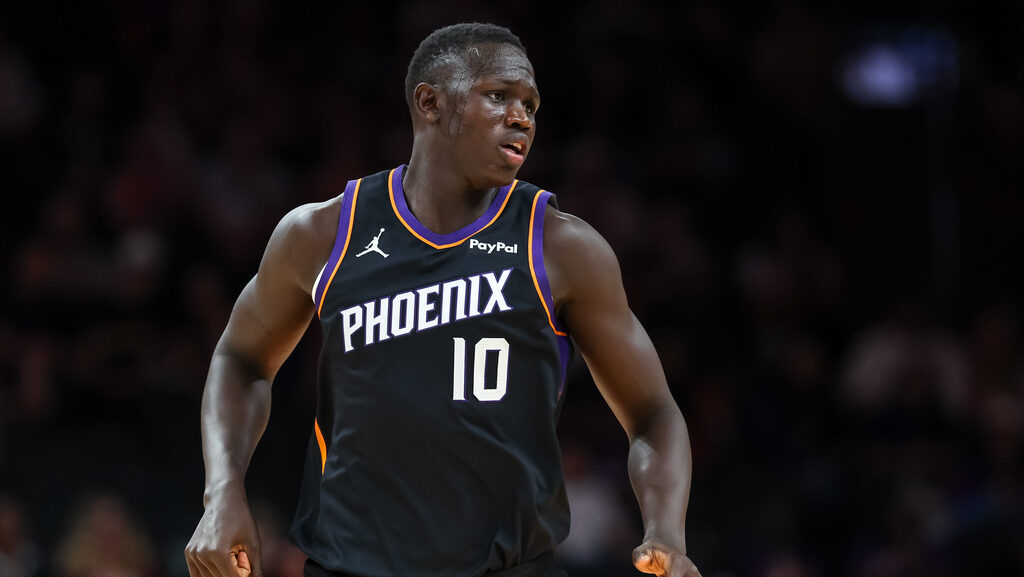
Phoenix Suns center Khaman Maluach (10) looks on during the second half of an NBA basketball game, Sunday, Nov 2, 2025, in Phoenix. (AP Photo/Mike Christy)
(AP Photo/Mike Christy)
Context matters. Khaman Maluach left Duke as a 39-game freshman starter in 2024-25, but he was light on minutes and light on production.
The Phoenix Suns drafted him 10th overall, knowing that building his physicality was the starting priority. It wasn’t just about bulking up. It was about building a foundation to simply play more minutes.
This was never going to be like rookie Deandre Ayton coming out of Arizona as that team’s best player and looking like a lost puppy as a defensive anchor for a bad Suns team. Maluach needed to be capable of earning enough minutes to play through those mistakes — and for his physical limitations not to lead to those mistakes.
After all, this was a player who just last January played a season-high 28 minutes and puked on the court mid-game before leaving with cramps.
So how did he fare as a rookie with such a low starting point? The numbers suggest there was progress.
That will play into whether the Suns retain starting center Mark Williams, a restricted free agent who averaged 11.7 points and 8.0 rebounds in 60 games, ending the year struggling through another bout of injuries.
Between Mark Williams and Oso Ighodaro, the Suns did not get much for paint-deterring in 2025-26
As a team, the Suns were successful at limiting the volume of opponent shots inside 5 feet, with the 11th-fewest attempts per game allowed. It was a sign of the strong team defensive structure led by coach Jordan Ott.
But they were eighth-worst in opponent field goal percentage by allowing 65.8% shooting inside 5 feet (the NBA-wide range spanned 58.3% to 70%).
It reared its head in the postseason, when the Suns allowed a league-high 71.9% shooting inside 5 feet in their sweep at the hands of Oklahoma City. Yes, yes, the Thunder will do that to a lot of teams.
Did the man at the 5 spot matter?
In the regular season, opponents shot 69.1% inside 5 feet when Williams was in the game.
Phoenix held opponents to 64.9% shooting inside 5 feet during Ighodaro’s minutes and an even lower 57.4% in Maluach’s short time on the court.
Now, onto the more individualized Second Spectrum tracking data (to also take with a grain of salt):
Williams averaged 5.0 field goals defended at the rim per his 23.7 minutes played. The shots defended per game and accuracy allowed were similar to those of 35-year-old Boston Celtics center Nikola Vucevic, who isn’t necessarily known for his defense these days.
According to tracking data, Williams’ contests led to 64.8% shooting to Vucevic’s 64.9% at the rim, not great compared to the elite range of limited role players like rookie center Ryan Kalkbrenner (54.9%) or veteran Ivica Zubac (55.2%).
Maluach’s 411 minutes played during the regular season produced an — eyeball emojis — 47% opponent accuracy at the rim. It came with a drastic improvement before the All-Star break (61.8%) to after (40.7%). The tape from the Suns’ playoff series against the Thunder mirrored Maluach’s progress.
Meanwhile, Williams and Ighodaro’s numbers held relatively steady in the front- versus back-halves of the 2025-26 campaign.
In other words, when he played, Maluach bothered opponents like the elite rim protectors in the league. It’s another animal to stretch that out to even 20 minutes per game regularly, and it’s notable that Ott protected the rookie, playing him intentionally when certain opponents weren’t on the court.
There is more to paint protection for an NBA center. Maluach has to learn how to screen, know where to be on offense and prove to be a capable switcher to build trust.
But the progress of his elite skill was something.
The Mark Williams vs. Khaman Maluach conundrum
It’s true that Williams’ ability to get 7.3 shots in the paint and on 64% accuracy can’t be underestimated. That rim pressure accounts for a ton of what Ighodaro currently can’t do, and Maluach lands somewhere in between them in terms of the shot attempt volume he can generate.
Rim pressure was sorely missing with Ighodaro trying to be any sort of scoring threat at all in the postseason — a thing even worsened by Phoenix’s lack of downhill-oriented perimeter players.
Williams and Maluach reflect similarly to each other as rebounding presences. Their rebound rates were significantly better than Ighodaro’s.
And if you dive into the cumulative advanced stats like box plus-minus, VORP or win shares, you will see Williams easily was a top-six player for Phoenix last season. That can’t be taken for granted.
As my Empire of the Suns podcast co-host Kellan Olson wrote about a few weeks ago, it then becomes a question of whether paying to retain him will harm the potential returns of fellow top-six producers Collin Gillespie or Jordan Goodwin, who are unrestricted free agents.
And relatedly, could the two guards’ impact in 2026-27 be buffered by Jalen Green and Grayson Allen being healthy and playing more?
The market pricing Gillespie or Goodwin out of a Suns return, which is related to Green’s and Allen’s future here, changes the calculus. Phoenix trading Green or Allen changes the math the other direction.
Saying all that, the Maluach conversation boils down to this: The Suns have a tough call on bringing Williams back and would have to be betting on his health. They are not in control of the free agent market, which could help them retain Williams and keep them from running it back with Gillespie and Goodwin.
The Suns are in control of Maluach’s future, and if they saw enough internal progress for the still very raw 19-year-old, there are enough numbers to bet on him next season as the elite rim protector they drafted.
Related
 Khaman Maluach fares well with Wembanyama matchup in Suns preseason
 Devin Booker ruled out for Suns’ preseason game vs. Spurs
 Miles Bridges’ ankle injury not expected to be serious
 Devin Booker and his dogs launch collab with Stanley: ‘Hidden in Plain Sight’
 ESPN’s Golliver: Suns’ biggest roster hole is lack of a proven starting-caliber center
 Early Suns preseason takeaways include pace, rotation clues and free throws

Comments
16 Comments
Thank-you Kevin Zimmerman! Numbers don’t lie. For all you Mark Williams fans, what this outstanding article by Mr. Zimmerman means is that all of you suffer from confirmation bias. You want Williams to be everything Ayton wasn’t yet Ayton is still the better center.
The specific comparison Mr. Zimmerman used with Nikola Vucevic should really be the deal breaker. Boston HC Joe Mazzulla benched Vucevic in the playoffs due to his horrendous defense.
Let Mark Williams walk! I’d say run but he would worsen that stress fracture in his left foot.
The center everybody will be looking at is OKC’s Isaiah Hartenstein. Thunder has a team option of $28.5 million. If the Thunder keep Isaiah and Dort, they will over the cap by 100 million. Thunder has an $18.2 million option on Dort. Thunder save around $47 million letting them both walk.
My point is that I don’t care about Ayton either. Suns are strapped financially and Im not paying $10 to $15 million to a guy who hasten available his whole career. Suns are going no where. Sign another youngster and throw him and Maluach out on the court.