
Suns’ NBA Draft history, new tools tell us they will trade up from No. 47
The Phoenix Suns will be able to trade up in the second round of the NBA Draft if they want to, and they usually do.

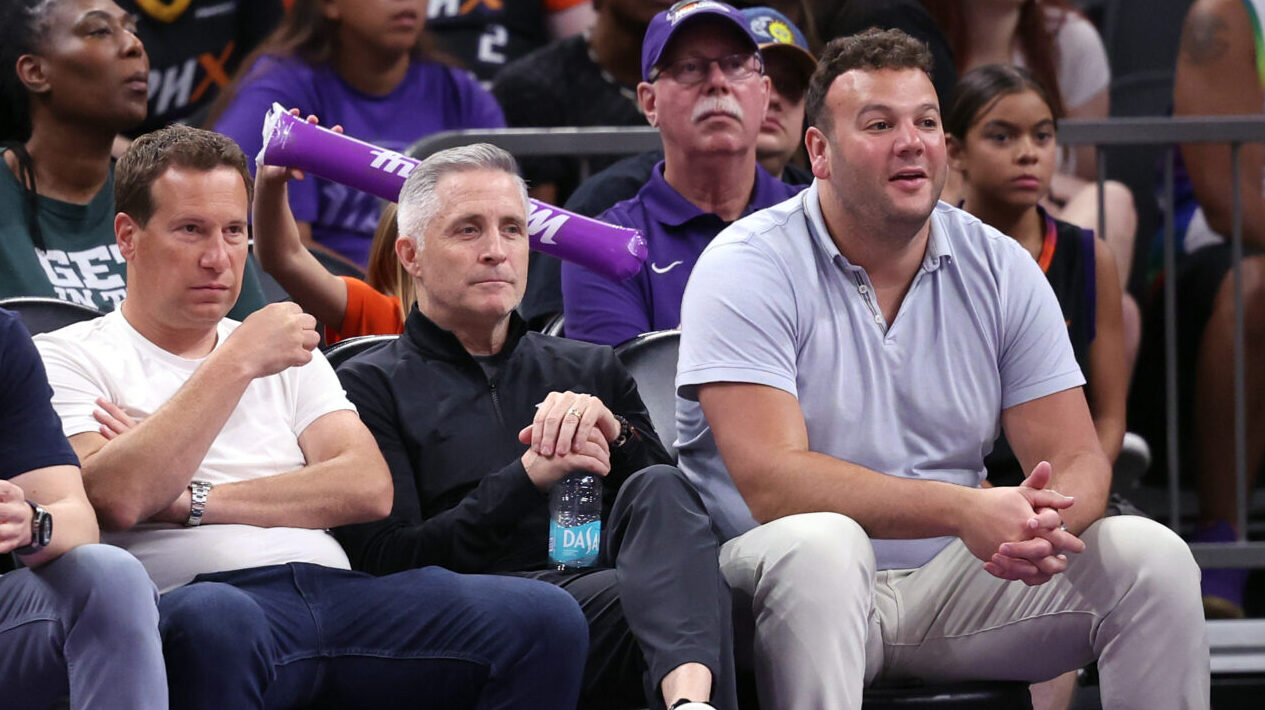
Phoenix Suns and Mercury owner Mat Ishbia, Phoenix Suns general manager Brian Gregory and Phoenix Suns and Mercury CEO Josh Bartelstein watch the action during the game between the Phoenix Mercury and the Minnesota Lynx at PHX Arena on July 09, 2025 in Phoenix, Arizona. NOTE TO USER: User expressly acknowledges and agrees that, by downloading and or using this photograph, User is consenting to the terms and conditions of the Getty Images License Agreement. (Photo by Chris Coduto/Getty Images)
(Photo by Chris Coduto/Getty Images)
No one has done more in the second round of the NBA Draft the past two years than the Phoenix Suns, and it is fittingly where they will in all likelihood get to work once more on June 24.
Phoenix has one selection as of now, pick No. 47, and heads into one of the busiest transactional periods of the year coming off back-to-back drafts during which it wheeled and dealed to get its guy in the second round.
In 2024, the Suns entered the night with pick Nos. 22 and 51. After trading down from 22nd to 28th to pick Ryan Dunn, they received pick No. 56 and two future second-rounders. Phoenix then swapped Nos. 51 and 56 to get up to 40th and select Oso Ighodaro.
Last year, Phoenix entered the second day of the draft with picks Nos. 52 and 59. Then, hours before the second round began, it dealt two future second-rounders to snag 36th overall. From there, Nos. 36 and two more future second-rounders were sent out for the 31st pick, where Rasheer Fleming was selected. With Phoenix still owning those two picks in the 50s, it dealt those for No. 41 to take Koby Brea.
We’ve got a lot of information to unpack there that will provide hints of what is to come.
For one, they have executed three trades in the last two years using future second-rounders to get a current selection. So, do they have any future 2nds? Why yes, they do. The Suns will have two more available, their own in 2029 and 2033.
It is notable that all of those trades did not include any of the Suns’ second-round picks and they presumably have more value than most given the lack of long-term talent on the roster at the moment. Getting to at least the mid-30s for that pair should be cake, as we saw them do with Brooklyn one trade before using No. 36 as part of the package for Fleming.
The other major trend is the Suns want to move up to the first half of the second round if possible. Yes, it’s ironic that this follows picking Toumani Camara 52nd in 2023, but Ighodaro and Brea both came as a result of moving up out of the 50s, while the Fleming trade was more of a calculated targeting.
Even after Camara proved to be a success in Portland, it is extremely difficult to find rotation players through picks Nos. 46-60. This has been the case for many years, before the NIL surge has greatly depleted the talent in the second round the past few drafts. It is now nearly two dozen players a year placed anywhere from the first-round bubble to cemented in the second round that will go back to college, where a better payday lies than any of these contracts (Adam Silver needs to get on that pronto, by the way). The talent there is rough these days.
A quick history lesson of why moving out of No. 47 should be a priority regardless.
If you play 25 minutes per game across 70 games for six seasons, you’ll cross the 10,000-minute plateau. It’s a good mile marker for an NBA veteran that has held at least a decently important role for a few years. Since 2000, there have been 22 players drafted in that back-half of the second round (Nos. 46-60) to reach 10K minutes, per Stathead. Take in the handful of recent drafts of players that haven’t been in the league long enough to reach those minutes totals and that’s an average of roughly one per draft.
That is grim!
Let’s shorten the requirements, though, and just look for useful players instead of concrete NBA veterans.
To go beyond simple data and introduce some more refined analytics, long-time readers will remember KTTAG, a new metric that has made waves in draft circles for the last several years known as “Kellan Thinks They Are Good.” This is another way of saying this player at one point graded as a useful rotation player for at least a full season, or still is. A better way to contextualize this is if they got a decent contract in free agency at some point.
KTTAG flags 17 players from 2014-23 through a recent 10-draft period: Raul Neto (No. 47, 2013), James Ennis (No. 50, 2013), Jordan Clarkson (No. 46, 2014), Norman Powell (No. 46, 2015), Georges Niang (No. 50, 2016), Monte Morris (No. 51, 2017), De’Anthony Melton (No. 46, 2018), Shake Milton (No. 54, 2018), Talen Horton-Tucker (No. 46, 2019), Terance Mann (No. 48, 2019), Isaiah Joe (No. 49, 2020), Sam Merrill (No. 60, 2020), Sandro Mamukelashvili (No. 54, 2021), Aaron Wiggins (No. 55, 2021), Vince Williams Jr. (No. 47, 2022), Gui Santos (No. 55, 2022) and Camara (No. 52, 2023).
That is not counting 2024’s Quinten Post (No. 52) or Cam Spencer (No. 53), nor 2025’s Kobe Sanders (No. 50), as well as guys like Dillon Brooks (No. 45, 2017) and Jamal Shead (No. 45, 2024) that were basically right there.
So that’s about two each draft. Still grim.
Go up to the front half of the second round, though, and KTTAG already identifies four dudes this year: Fleming (31st), Sion James (33rd), Ryan Kalkbrenner (34th) and Maxime Raynaud (42nd). Go back to 2025 and we’ve got Ajay Mitchell (38th), Jaylen Wells (39th), Ighodaro (40th), Adem Bona (41st), Pelle Larsson (44th) and Shead (45th).
That’s 10 guys right there just in the last two years alone, and surely at least one more emerges as a late bloomer.
The Suns want to get up there. And this year, they have a new way of doing so.
By escaping the second apron, the Suns can now use cash in trades. Last season, NBA teams were allowed to send a total of roughly $8 million in cash over the course of the full season. That was the full allotment. Phoenix, for example, included $4.5 million when trading Nigel Hayes-Davis to Milwaukee, so it had about $3.5 million left to use at its disposal.
With a new cap number next year, the cash allotment presumably goes up a few ticks, but let’s just have it around there for the sake of convenience to our discussion right now. Crucially, that allotment resets going into a new league year, and the majority of draft-day trades can wait to become official in July. All of Phoenix’s movement last year didn’t go through until July 6.
Meaning, the Suns will have that full piggy bank to go shopping for second-rounders, one of the most common uses of cash in trades.
Here is some defined value from last season: The Los Angeles Lakers traded pick No. 45 and $3.3 million for 36th overall to take Adou Thiero, and two picks later the Indiana Pacers acquired No. 38 from the San Antonio Spurs in exchange for a 2030 second-rounder and $2.5 million to select Kam Jones.
All of this is to say that we constantly talk ourselves into how easy a trade can be to get done, but in this instance, it totally is. If Phoenix wants to move up roughly 10 spots or more in the second round, it will, whether by using future second-round picks, cash or both. For all of our talk about how thin its war chest of assets is, in this hyper-specific realm, it’s actually quite well stocked.
You do wonder if they could use all of that arsenal to even touch the last few picks of the first round, where there is precedent for teams wanting to move out because it does not want to give any of the available prospects a guaranteed two-year contract, as is required for all first-round selections.
Get ready for some movement.
Related
 Yahoo Sports' Kevin O'Connor mocks disruptive big Izaiyah Nelson to Suns
 Do NBA Draft lottery changes hurt or help Suns' unprotected traded picks?
 Suns' Jordan Ott finishes top 5 in Coach of the Year voting
 What could Suns C Mark Williams make in free agency? ESPN's Bobby Marks projects an offer
 Suns acquire Ja Morant in would-be blockbuster trade proposed by ESPN
 Dillon Brooks needed less than 5 minutes of preseason basketball to stir something up
Comments
5 Comments
😂
Did you read every word and statistic?
Ready for your pop-quiz?
Boy! Great analysis ✊🏾