
Suns re-signing Mark Williams adds risk and uncertainty to C picture
The Phoenix Suns have to hope they see more consistency out of Mark Williams in order for his new contract to pay off.

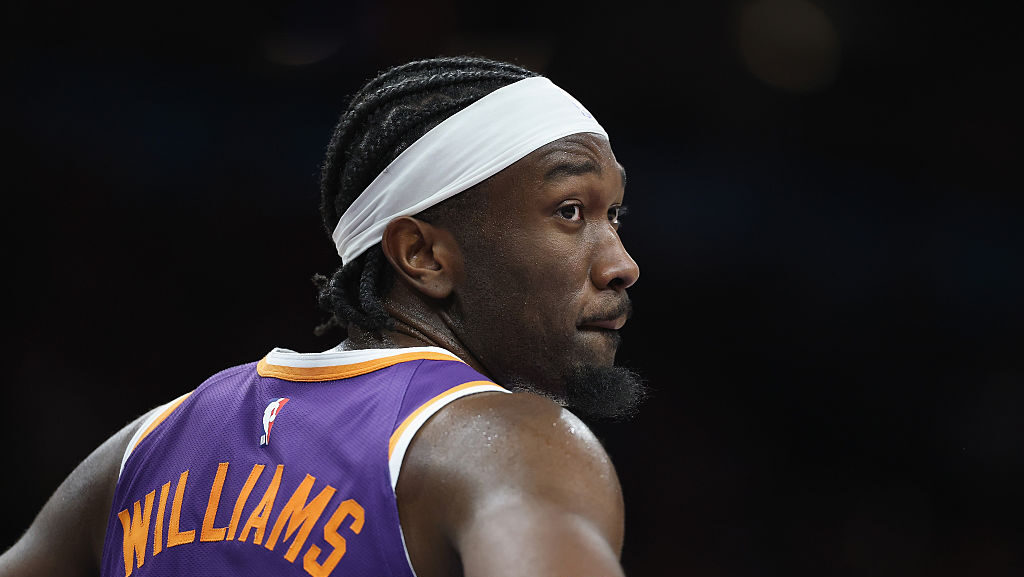
Mark Williams #15 of the Phoenix Suns during the second half of the NBA game at Mortgage Matchup Center on November 10, 2025 in Phoenix, Arizona. (Photo by Christian Petersen/Getty Images)
(Photo by Christian Petersen/Getty Images)
The Phoenix Suns agreed to re-sign center Mark Williams to a three-year, $38 million deal on Thursday, adding more risk to a salary sheet that can’t afford any and uncertainty to the big man rotation.
Williams’ contract is fully guaranteed with no options. That is why the price is that low. With that said, the central point on a discussion surrounding this deal depends on how tradeable you believe the contract to be if Williams proves to be as ineffective as he was in the last three-fourths of the season or if he continues to get injured.
If either of those things happen, I do not think the Suns will be able to get off this contract. If you disagree, then the Suns are totally fine and this is a solid contract.
I have my doubts.
There are layers upon layers of factors that have to work out in order for the totality of this center rotation to have a happy ending.
To begin, the Suns set themselves up to take a moderate loss of value one way or another when trading for Williams and drafting Khaman Maluach 10th overall minutes later last summer.
The only way this worked out was if Williams exceeded his standing as a top-20 center to prove he was more, and in the process, raised his own value. In that reality, by the time Williams fully established that, Maluach would theoretically be ready to take over, and that’s when Phoenix could trade Williams for even more than it originally gave up.
That was the lone win condition, and it has not shown positive signs from either player through one season. Instead, one of the many possibilities for how this could go wrong has unfolded thus far.
Before we get into what will be a good amount of criticism for Williams’ play, it should be stated he’s evaluated through a harsher lens because of what he has to be in order for this situation to pan out. Even with the low points, he was still an effective player for Phoenix through chunks of the season, whether it was more good or great. That obviously had its benefits.
Prefacing all that, Williams wasn’t even the best center on the team. Second-year big Oso Ighodaro earned more and more trust from head coach Jordan Ott while it faded in Williams. Williams did record career-highs in games played and minutes, but the year ended with a foot injury and a re-aggravation of it, once more turning the focus to his failed medicals from the previously nixed trade that would have sent him to the Los Angeles Lakers. While it was progress, there wasn’t enough of make you feel confident Williams isn’t fragile anymore.
At the time of the trade, beyond the unsteady feeling surrounding Williams’ health, it was also a mystery box as to how he would perform in a winning environment. The Charlotte Hornets’ emergence was not underway until he departed. Phoenix and every other team wouldn’t know how he looked inside a proper basketball ecosystem until placing him in one. The Suns did, and the results were inconsistent.
Your eyes told you what the numbers also did.
A quarter of the way through the season, 22 games for Phoenix and 18 for Williams, it outscored teams by 6.8 points per 100 possessions when he was out there, the best for any starter on the team. From that point on — Dec. 5 to be exact — Williams posted a -6.3 net rating over the Suns’ final 60 contests and his 42, the worst of any rotation player, let alone starter.
Even though Williams was a reliable finisher with space around the rim, still a good overall rebounder despite an inconsistent motor and racked up deflections on defense, his limitations were damning.
On offense, Williams was surpassed by a far smaller Ighodaro as a screen-setter and roller. Williams could never get on the same page as his ball-handlers and oftentimes that resulted in a turnover or Williams not getting the ball when he was actually open. His desire on the offensive glass waned the longer the season went on, and it was a common sight to see him floating around or back toward the basket instead of crashing with a ruthless mindset like many of his teammates.
Defensively, his positioning constantly frustrated the coaching staff. They didn’t say as much but you could see it in the reactions from the bench and when Williams was subbed out. As the season progressed, the amount of time it took for Ott to turn to Ighodaro shrunk by the game. The lack of impactful defense really showed in Williams’ block numbers, where despite preposterous length that is among the best in the entire league, he totaled 55 blocks in 60 games. He actually had just as many steals (55).
Ighodaro became far and away Phoenix’s best option on defense in the big rotation, let alone the positives he brought offensively with his passing and occasional driving. While the 6-foot-11 center frustrated segments of fans due to his lack of scoring ability, size to contribute on the glass and inability to make free throws, he was the Suns’ best big man. And he did so in his second season, showing growth that bodes well for the future.
Williams will return as the starting center but how much grace Ott chooses to give him if the same patterns persist will be one of the biggest subplots of the season to monitor. And there’s also a chance that Ighodaro is even better than he was last year, which could make this even more awkward. Ighodaro was at 22 MPG last year, and that number cannot decrease. If anything it should go up a few ticks. He was one of the best reserve 5s in the NBA last season and has a good shot to be something more.
Which brings us to Maluach.
If part of your reaction to the Williams deal is that it insinuates the 19-year-old won’t even be ready to contribute next season, I wouldn’t blame you. Ott will likely turn to the three-center rotation he deployed at the start of last year with Nick Richards, but for the 17 games that all three centers played in before Richards was benched, he averaged 11 minutes per game. Is that enough time for both Maluach to improve with and for the Suns to find out what they’ve got in him?
Now, Maluach will get some real burn when Williams is injured. That will happen. But that shouldn’t be seen as a reason to still re-sign Williams. “Oh, he gets hurt sometimes, so he won’t really block Maluach that much anyway.” I don’t see that trade-off at all.
And if Maluach isn’t ready for more than 15 MPG, that’s an obvious problem. He is still raw and quite young. But the concern will mount the longer he’s unable to hold a rotation role.
Based on what we saw last season, Maluach would require a huge jump to be an effective reserve. It also indicated this staff is not going to put him in there until they believe he can handle it. The precedent for his lack of playing time as a top-10 pick is small, and the concrete fact is that tends to mean a guy is a bust. He of course isn’t one already and his rookie year was barely a data point worth justifiably reading into but this upcoming season will tell us a whole lot.
A better way of thinking about it is if Maluach can contribute in ways Williams can’t. A lot of those areas, though, come with experience. Screen-setting, timing on dives, positioning as an anchor, rotating for rebounds and so on. Maluach’s tremendous motor is an upgrade but these two physically and athletically are fairly similar. The only real difference in skillset is Maluach’s pending 3-point shot, which probably won’t be ready next year.
And you know what, that’s fine! Maluach has to use this season to refine those skills. As long as it comes with him really taking off toward the end of this year, looking like the definitive starter and best center on the team for 2027-28, it’s A-OK.
It just has to happen. The Suns’ entire ascension can’t function without Maluach turning into one of the better centers in basketball. He needs to be better than Williams at some point. And when that happens, Williams has to be tradeable, or else a team with $22 million in dead money for the next four years will have even more of a burden on its cap sheet, one it simply cannot afford.
Related
 Oso Ighodaro considered day-to-day after Suns feared more serious back injury
 Charles Barkley gets to try ‘Who He Play For?’ again, and again
 Suns forget they are the ‘try-hard team’ in blowout opening loss
 Oso Ighodaro exits Suns-Trail Blazers with apparent hip injury
 Suns reveal first starting lineup of the season with Khaman Maluach at center
 Luke Kennard out for Suns’ season opener against Portland

Comments
12 Comments
Hilarious! Oso sucks. Dunn sucks. And for added measure Pavin Smith sucks.
I have absolutely no faith whatsoever in Kellan's talent evaluations. I witnessed too many instances where when Williams wasn't available, that the Suns got absolutely destroyed, for example their last series vs OKC. Maluach may develop or it may take him another 2-3 years to get there.
Ighodaro has some defensive abilities, but his complete lack of anything resembling offensive skills, makes him a deep bench reserve at best, especially in the Pacific Division with it's plethora of excellent bigs.
As per usual, Kellan Olson confirms he's still spending way too much time sucking on the Crack Pipe. He just wrote an article defending the Suns drafting Koa Peat, which was bad enough, but then recruited Brian Gregory to give a ridiculous quote where he comparing Koa Peat with Aaron Gordon, completely ignoring how Gordon absolutely killed it at the Combine, massively increasing his stock, while Koa Peat stunk up the joint, winning the award numerous writers handed out to the worst player at the Combine. I wonder if Kellan dresses up in his UofPay Cheerleader outfit complete with pompoms and even does a few cheers to get himself warmed up, before he's going to write about someone from his beloved UofPay?
I must have watched a different Oso this year. Yea, he makes some plays here and there and sets nice screens, but he is a huge liability on offense, and he isn't a very good 1on1 defender on defense. And his horrible free throw shooting make him an even bigger liability in close 4th quarter games. And if you have him and Dunn on the floor at the same time, its like playing 3 vs 5 when the Suns are on offense (plus he is also sub .500 on free throws, yikes!!) LOL
Maluach wasn't drafted 10th because he was ready to start day 1. His potential is obvious, but he was drafted at 18 with only a few years of basketball under his belt, so ease up on calling him a bust already. When Williams contract runs out, Maluach will be 22. If he isn't ready to be the 30+ minute starting center at that point, than yea, he's a bust.