
Early Suns preseason takeaways include pace, rotation clues and free throws
Will the Suns play faster? Who starts at center? The start of the preseason gave us some clues.

Watch: What to make of Dillon Brooks stirring up trouble in the first 5 minutes of the NBA preseason | 8 mins
Eight quarters of preseason basketball isn’t much to glean from, right? Right?
Wrong!
We’ve got some initial observations to dive deeper into on the 2026-27 Phoenix Suns. Let’s springboard right in.
The Suns look like they’ll pick up the tempo
Preseason, let alone the first month of the season, will include teams adapting a playstyle they set as a goal. They will mostly achieve this initially before an inevitable tailing off comes at some point in the year. As much as I hate to say it, this happened to the Suns last year with their defense. The intensity dropped substantially for the last two months of last year.
But even if that did happen, it did set a standard going forward, which is huge.
If the Suns can accomplish something similar this season offensively with their pace, that is the easiest path toward becoming a top-half offense in the league. And if they do that while retaining the top-10 defense they were last year, we’re talking somewhere in the range of 50 wins.
Phoenix has weaknesses in its starting lineup on both ends, but primarily on offense, where a large gap in playmaking between Devin Booker and everyone else is magnified by the worst quartet of perimeter shooting any team in the NBA will field to begin the year.
How do you cover for this? Run!
The A-B-C of the idea is that playing off a miss doesn’t let the defense get set, so space will already be there. And while the likes of Miles Bridges and Jalen Green make questionable dribble decisions that we’ve seen some of already, they can make the simple play in semi-transition.
There was lots of this to begin with in Monday’s 109-107 loss to the Detroit Pistons. A bonus of Oso Ighodaro starting is that he can grab-and-go with rebounds too.
Bridges and Green are obviously high-tier athletes, too. That is where they’d love to be as much as possible. It’s just going to be on them and the ball-handlers to bring that pace.
The Monty Williams Suns were awesome at this on both ends of the floor. Transition effort was a nonnegotiable. The clip below is from the Western Conference Finals — so obviously everyone is playing their ass off — but just watch what Torrey Craig sprinting ahead of Booker here opens up since now-Sun Luke Kennard has to track Craig.
Watch Craig then Kennard then Booker. Effort goes a long way https://t.co/x1SfHOgCvE
— Kellan Olson (@KellanOlson) June 21, 2021
Booker is going to be in a similar position all year for these Suns. His teammates have to aid him where they can. The easiest way is to run.
It was about Year 3 or 4 when Booker picked up on how important semi-transition would help him find extra clean looks, and he knows its importance for this team better than anyone. He didn’t have much energy on Wednesday in a loss to the Chicago Bulls. Booker took too many pull-up 3s in the halfcourt and got stuck in a staring contest with Scott Foster’s crew trying to draw shooting fouls, so that resulted in a 3-for-14 evening.
He’s got to set the example for how the team will run, and then requires support after that.
Bridges has to be a hair-on-fire guy in that regard, and Green should be too. Tracking their commitment to running in the first dozen or so games will be one of the top off-ball things to watch to begin the season. Both of them, particularly Green on the ball defensively, showed some positive signs in the two exhibitions.
Tea leaves? Or decision already made?
With everyone available outside of Mark Williams, Ighodaro started at center on both Monday and Wednesday, ahead of Khaman Maluach. There are still three preseason games left and head coach Jordan Ott said they’d mix and match, so who knows how indicative this is of the decision that has to be made.
You’d presume, though, that Ighodaro is now the favorite.
The simplest way to put it is that Ighodaro makes everyone better whenever he’s out there, and Maluach, through his learning curves, will by default make everyone a little worse when he’s out there. If Ighodaro starts, it’s also another signal that Maluach still has a ton of room to grow before he can become dependable, as his absence from last year’s rotation forecasted as well.
While Ighodaro’s flawless chemistry with Collin Gillespie and the reserves made it seem like a bench nod may be best for him, along with his other weaknesses like his size and rebounding, how Ighodaro levels up the accentuating parts of the other starters might be the 4D chess move here. Ott went out of his way in the first week of training camp to compliment how guys “instantly” play better with Ighodaro. The question was on Luke Kennard, but Ott perhaps was talking about the starters just as much.
If you’re not convinced on Ighodaro, here are some examples.
This might seem like an innocuous play where Ighodaro did hardly anything, but as he grabs the rebound, his options for an outlet are Jordan Goodwin and Dillon Brooks, two guys that aren’t necessarily going to start the offense.
By Ighodaro dribbling the ball up to halfcourt, he challenges the Pistons to at least match up defensively. He looks up, sees Cade Cunningham drifting toward an already-covered Green, and it’s two simple passes for an open 3.
Oso grab & go’s are going to be come both a norm & weapon this season.
Scans & peep’s Detroit isn’t matched up, so the skip & +1 leads to a WIDE open Dillon Brooks 3. https://t.co/hMzFhXPY2k
— Stephen PridGeon-Garner 🏁 (@StephenPG3) October 5, 2026
Here is Ighodaro serving as a “hub.” Again, this looks basic, but he’s evaluating options and where the space is before Booker gets a free layup on a read these two can make together in their sleep.
One Thing, Every Game
Preseason Gm 1 @ DET
“Know Who You Are” https://t.co/lCwMEMf4cP
— David (@theIVpointplay) October 6, 2026
Defensively, it’s really everything. The clear separator, though, is how Ighodaro can move his feet.
He shuts down a few possessions each night with how quickly he shuffles on the perimeter, whether that’s directly on the ball in a switch or as the help defender elsewhere.
Here’s Oso Ighodaro switching onto 4 of the 5 Pistons. https://t.co/TNurWhHkQ5
— Mike Vigil (@protectedpick) October 5, 2026
It cannot be overstated enough that having Ighodaro as a pick-and-roll defensive partner will not only make the Suns’ starting perimeter defenders better, but he will also clean up mistakes with his agility and IQ. Maluach can mop some stuff up around the rim, but that’s more happenstance because he’s tall, whereas Ighodaro’s janitorial services can affect every play.
These are things Maluach cannot do, even if he realizes his potential. He’s not that type of player.
For Maluach in these two games, it was more of what we saw from him as a rookie. Some good. Some bad. He still looks raw, as expected.
It is crucial to use the correct lens when watching Maluach. Rightfully so, fans are looking for flashes, some bright spots to be optimistic about. The Suns want to see those too, but with this type of starting decision, it’s more about how he makes the Suns better.
The flashes were there, and so were the mistakes. He made a handful on Wednesday, and it’s stuff like ball-watching and falling asleep as he makes an outlet pass.
Those will come, and the Suns will be fine with that. Just not in the starting lineup and playing over 20-plus minutes a night until he proves he can outperform those hiccups with major contributions elsewhere. And eliminate the mistakes.
Wing roulette
The biggest surprise of the rotation, should it hold up for opening night on Oct. 21, was Ryan Dunn getting the nod ahead of Rasheer Fleming as the final perimeter player off the bench behind Gillespie, Goodwin and Kennard.
The organization has been right there along with the fanbase in their excitement for the tantalizing upside of Fleming. In the offseason before the Bridges trade, you would have guessed he was more likely to start than not have a rotation spot on opening night.
It’s also unquestionable that Dunn regressed last year, losing his ability to be a non-zero offensively and having far less impact on defense. So what does he have working for him?
This is my guess at what the argument is. And you’ll notice I’m finding cracks in it as I try to see the other perspective, because I think it would be bananas if Fleming takes a DNP in Portland for the opener.
The most obvious thing is experience.
This is to no fault of Fleming, but he had his fair share of those moments last year. In Year 2, you’d expect those to largely fade. Fleming allowed a blow-by on Wednesday, and Ott promptly took him out of the game after a timeout, subbing back in Dunn. Case in point.
That edge showed the most with passing. Dunn nearly doubled his assist percentage in his sophomore season, going from 5.7% to 10.3%. He can make the extra pass or even a one-to-two-dribble dump-off or kick-out feed. Those are the areas where Fleming looks very elementary right now, getting designated more as a play finisher. He finished with 16 assists last year in 673 minutes. Their turnover percentages were fairly similar.
Dunn is one of the better rebounders on the team. Among non-centers, his rebounding percentage was actually tied with Goodwin — perhaps the best rebounding guard in the NBA — for the best on the Suns. Phoenix needs its wings to be productive on the glass. Is Fleming a bad rebounder? No. But we’ve established Dunn is a very good one.
Lastly, the team played very well last year when Dunn was out there with the key guys, despite his own struggles. He had a 7.4 net rating with Gillespie and an 8.1 with Booker, the pair I’d designate as the drivers of the offense when they’re out there. It should be said, though, that Fleming in about half the minutes with Gillespie rocked an 8.7, and 165 minutes with Booker posted a 10.4.
This decision will be a perfect representation of how Ott and his staff will prioritize winning over development. Fleming’s ceiling as a player has been well discussed already by everyone, including the team, and the only way for him to discover it is with playing time. It is far higher than Dunn’s, even if Dunn gets back to how he played as a rookie. But if Dunn does do that this season, he will give the Suns a better chance to win each night.
More like pay throws
Phoenix’s free-throw shooting was a disaster on Monday, going 17-of-33 (52%). Wednesday saw a big jump back to 76%, and if anything, tells us we could see some fluctuation this year.
This isn’t a problem for the main scorers. Booker (87% career FT shooter), Green (80%), Brooks (81%), Bridges (83%) and Gillespie (85%) are all great. It’s the supporting cast where issues lie, more specifically the draftees.
Maluach shot 77% in college on 77 attempts, a sample size too small to definitively say he’s a good shooter and decently sized enough that he’s not a bad one. Ighodaro is a bad one. He’s at 49% in the NBA after 62% in college.
We briefly saw Hack-A-Oso last year, and it’s only going to pick up if he’s below 60%. That is when the juice becomes worth the squeeze for opposing teams.
Dunn isn’t much better. It was 53% in college before 49% as a pro. Peat was only at 63% for Arizona, so he will struggle too.
In the two games, that foursome combined to shoot 5-for-15 at the foul line. Maluach bounced back from an 0-for-3 Monday by going 4-for-5 on Wednesday. Ighodaro is 1-of-4 in the preseason, while Peat was 0-for-3 and Dunn hasn’t taken one yet.
This shouldn’t be seen as a weakness of the team. Last year, out of the 1,663 free throws the Suns attempted, 43% of them were taken by just Booker and Brooks. Throw in a full season of Green and Bridges, and that number should get closer to 70%.
It’s the other 30% that will be a small problem throughout the year, and gets much larger for Ighodaro specifically if this turns into something where Ott can’t have him closing games anymore.
Related
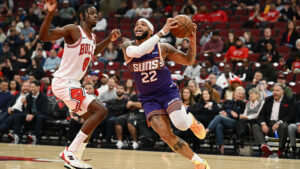 Miles Bridges exits Suns’ second preseason game with apparent ankle injury
 Dillon Brooks is up to more shenanigans, once again with Benny the Bull
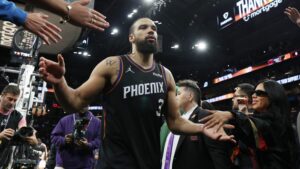 Dillon Brooks needed less than 5 minutes of preseason basketball to stir something up
 ‘I was ready to kill him’: Dillon Brooks’ unique mentoring pushes Suns
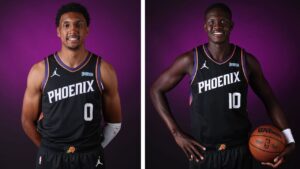 Suns exercise 4th-year option on Ryan Dunn, 3rd-year option on Khaman Maluach
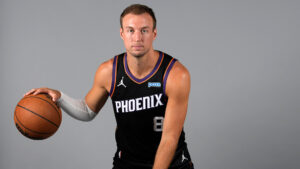 Luke Kennard has had to fit in with many teams, says Suns transition has been easy
Comments
0 Comments