
Does NBA have tangible solutions if it looks into tweaks to reduce injuries?
Cam Johnson provided his thoughts on some tweaks suggested to potentially help reduce the number of injuries in the NBA.

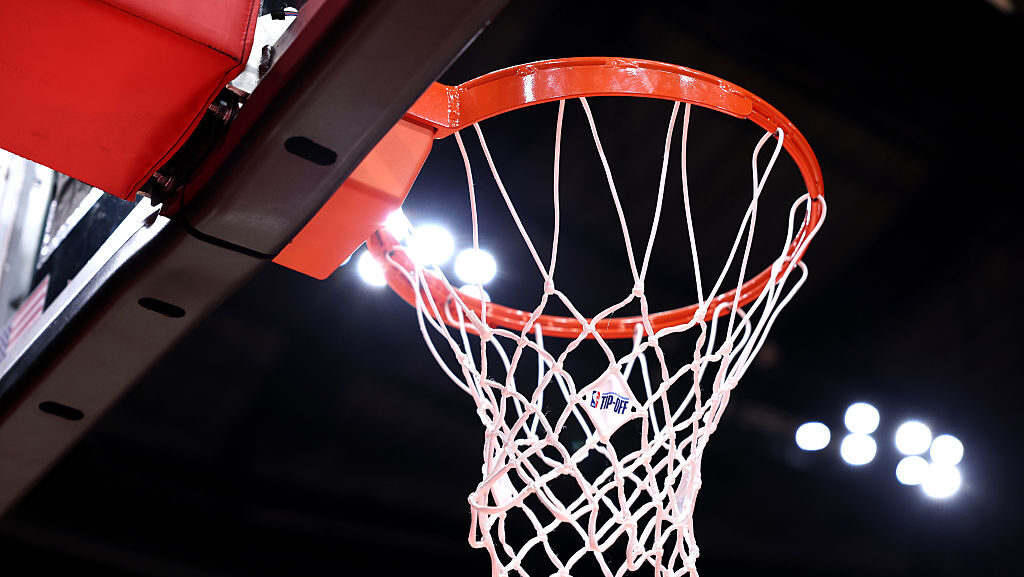
HOUSTON, TEXAS - OCTOBER 21: A detailed view of the American Express Tip-Off logo in the net prior to the game between the Dallas Mavericks and the Houston Rockets at Toyota Center on October 21, 2026 in Houston, Texas. (Photo by Kenneth Richmond/Getty Images)
(Photo by Kenneth Richmond/Getty Images)
PHOENIX — Another start of an NBA season filled with injuries sparked more discourse and dialogue on how much the sport has changed and if the league, as a result, will have to change to keep its players healthier.
This debate has been going on for a handful of years. The league has continued to come out and diffuse a tone of urgency from attempts at deeper investigations into the number and types of injuries. Commissioner Adam Silver has continued to say it’s not at a point where looking into changes is necessary, while also noting the NBA is obviously concerned.
What is not up for debate is how differently the game is played now. Players are asked to do far more on a possession-to-possession basis, and in different types of ways. Arizona Sports spoke with former Phoenix Sun Grayson Allen last year about this, and here’s what he said about the responsibilities.
“I think people argue that the pace of the game is different now, but it’s been matched in older seasons. I think [it’s] what’s happening with half-court offenses offensively — the game doesn’t rely on post-ups (anymore). We’re pushing the pace, but it’s also heavy drive-and-kick, a lot of downhill movement, a lot of movement offensively. And then defensively, you’re guarding closeouts and heavy drives, and you’re asking to push the pace and you’re asking to crash.”
“In a perfect world nowadays, (you) pick up full (court), you’re guarding multiple actions and cutters, rebounding, pushing the pace and crashing. Doing all of those things, I think it was just more of a feel of, ‘Hey, if I’m going to be asked to do all of those things or if this is how guards are being asked nowadays.’
If you have a four-minute stretch and you want to be able to do (all of) that, it’s a different level of shape than what I’ve done the first six, seven years of my career.”
That type of thought is supported by the numbers this season. Where the analytics revolution is currently impacting the game most is not with the 3-point shot, but with the data on having more possessions correlating to a better chance of winning, and how an offensive possession is less successful the longer it lasts. Thus, hard work is going into maximizing those edges.
It’s a week into the season and the NBA is averaging the most possessions per game, shortest average possession length, highest average pickup distance, and most possessions with at least three offensive players crashing in the tracking era. Playing very hard for 82 games!
— Caitlin Cooper (@C2_Cooper) October 27, 2026
What is part of the conversation now is, if the NBA ever decides change is necessary, what would that change be? And more so, is there even a good solution?
With an assist from The Zach Lowe Show that kicked around a few of these suggestions, I caught up with old friend Cam Johnson by tossing six tweaks at him while the Denver Nuggets were in town, with the suggestion for him to go as short or long as he wanted on each idea. Johnson’s got a great mind for the game, particularly this type of stuff, and his intrigued reaction to me telling him the concept confirmed I got the right man for the job.
To start, Johnson avoided any declarative stance on whether any of this is actually needed, and wants to see the numbers himself first.
“I would like to see the raw data before I get to saying that,” he told Arizona Sports, while also noting this is something to keep a close eye on.
OK. How do we fix this?
Shorten the games? How about a 40-minute game instead of 48?
“No,” Johnson said.
Absolutely not?
“Nope.”
Moving on!
With all the space players have to cover in this 3-point world, how about moving the 3-point line in?
“No, because then the 3s go way up. We’ve seen that already,” Johnson said.
Well said!
An odd one I personally had, not because I think it would work, but because I was curious what he thought about it was eliminating defensive three seconds.
This one got Johnson to at least pause and ponder.
“Hmmmm. What’s your reason?”
The thought was that defensive rotations toward the paint would be almost eliminated with a big man always in there, and perhaps give defenders less to do.
“But then you’d be settling for more 3s,” Johnson countered. “There’d just be a lot less shots in the paint, and people don’t want that I don’t think.”
Good thought. That sounds like a far less entertaining product.
Would a change in the rules defensively make sense? Toning down the physicality?
“Nah. Because then it’s just ticky-tack fouls all game and then the free throws go way up,” Johnson said. “Guys are going to play the way they play defensively. You introduce a severe rule like that, then the pace of the game is going to be slowed down with all the free throws.”
Again, this guy and his good points.
Expanded rosters?
“Nah. Seems like enough.”
Agreed.
Lastly, the big one. A 70-game season.
“It messes with a lot of things. I think of all the things that might be the most logical, but you can’t really say it (definitely),” Johnson said. “The game has been 82 games for so long. No league has ever cut games. Only leagues add games. I don’t know if that would have a direct correlation to injury prevention.
“It screws with money, it screws with TV deals, it screws with ticket revenue, so there’s a bigger picture, and you don’t even know what it’s going to fix. It’s not a last resort per se, but a more desperate measure of a change if the powers that be really feel like the league [needs a change].”
Overall, Johnson cosigned the worry, and that this has to be top of mind, while also kindly participating in a helpful exercise to showcase how challenging it will be to find the right tweak if one is later deemed necessary.
As a studious person, Johnson would want to really dive into all of the sports science numbers. Teams and the league have access to numerous levels of technology that can paint a far better picture of the physical demands the modern game puts on bodies.
This came to mind for Johnson with not how much players move on the floor now, but how they move on the floor now. The two common terms to emerge in the last decade are “acel” and “decel,” short for acceleration and deceleration. The agile and sudden nature of how players with and without the ball either instantly speed all the way up or down has to be some type of factor.
“I think another thing (is) the type of movements we do are a little different. The type of movements that players are trying to do, that players work on are a little bit more dynamic maybe? Not saying guys didn’t do it before, but I would like to see the numbers on acel, decel, change of direction, stuff like that too,” Johnson said.
After taking a few seconds to think if he had anything more to add on the subject, Johnson brought up another bullet point that has come up. These days on the youth levels of the AAU circuit, kids never stop playing not only basketball, but competitive basketball. Johnson didn’t want to go as far as concretely saying kids a few decades back weren’t playing as much high-stress basketball, but I will. They weren’t.
“I’ve heard the argument that people are playing so much from the youth on up, and really no offseason. … “The generations coming through have played more basketball, worked on more basketball, I feel than the generations before,” Johnson said. “Maybe guys played at he park (just as much), but organized (play), it’s high wear-and-tear stuff.”
There is no slowing down how the game is changing. In all likelihood, it will get even faster. Even more taxing. It feels like we’re headed toward something new to keep the best in the world healthier and more available to the consumer. Whether that’s in three years, five or 10. For now, brainstorming will have to keep commencing, providing suggestions to the smarter guys who know the game best so they can land on what is ultimately best.
Related
 Arizona Sports’ John Gambadoro taking Suns pregame free throw: ‘I don’t get nervous’
 Suns fall to 25th in The Athletic’s latest NBA power rankings
 Suns’ Jordan Goodwin questionable ahead of Trail Blazers matchup
 ‘It’s fake toughness’: Warriors’ Charles Bassey calls out Suns after win
 Suns still searching for breakthrough, lose 3rd straight to Warriors
 Draymond Green ejected after getting into it with Dillon Brooks during Suns-Warriors
Comments
0 Comments